


09 Apr Iran War Misconceptions
“Three quarters of the factors on which action in war is based are wrapped in a fog of greater or lesser uncertainty.” – Carl von Clausewitz
“Beware the ‘fog of war.’” – The Lonely Realist
When asked in 1972 about the impact of the French Revolution, Chinese premier Zhou Enlai replied that it was too early to tell. Given that the French Revolution had occurred nearly 200 years earlier, Zhou Enlai was viewed as having expressed the long view of history. Long-term perspectives, after all, are unclouded by parochialism and myopia. That’s not true with respect to nearer-term perspectives, those within 20 years or 2 years or 2 months. The fog that lingers over those closer-in-time historical events is fraught with both narrow-mindedness and von Clausewitz’ uncertainties. The Iran War is just such a near-term event. At barely 6 weeks of age, any “conceptions” are misconceptions, necessarily flawed because they all too often are based on myopia and partisanship.
Many of today’s misconceptions about the Iran War are the result of President Trump’s desire to be the 21st Century’s “Great Disrupter.” His statements about America’s goals, intentions and strategies have been intentionally ambiguous, inconsistent, inaccurate, at times inflammatory and unsettling and at other times pacifying and stabilizing (“The President has regularly issued incendiary threats when markets are closed and walked them back just before markets re-open”). Supporters justify his approach as an ingenious geopolitical application of “The Art of the Deal” – that is, the Trumpian version of Nixon’s “Madman Theory.” Others treat his statements as the incoherent, deranged rantings of a true madman. Neither view is accurate. Each embodies a partisan predisposition. The President indeed is highly skilled at obfuscation and manipulation, all in an effort to apply transactional dealmaking to geopolitics. History will decide whether his efforts are an exercise in performance art or merely bluster…, or, worse, insanity.
Too many commentators nevertheless have reached highly speculative definitive conclusions about the winners and losers of the Iran War. Those favoring MAGA and America First principles believe that America already has won. Relying on information released by American military sources, they point to “the radical degradation” of Iran’s nuclear program, the destruction of “most of” Iran’s ballistic missiles and “some of” its drones, and the elimination of a generation of regime leaders. Those seeing things differently are anchored in the belief that retreat from the post-WWII American-led world order and historical analogues mean that America will be the ultimate loser, emphasizing the Theocracy’s newly-established leverage over global energy (gas and fertilizer) prices through its control of the Strait of Hormuz. Both perspectives suffer from misconceptions – in short, and quoting Chou Enlai, “It’s too early to say.”
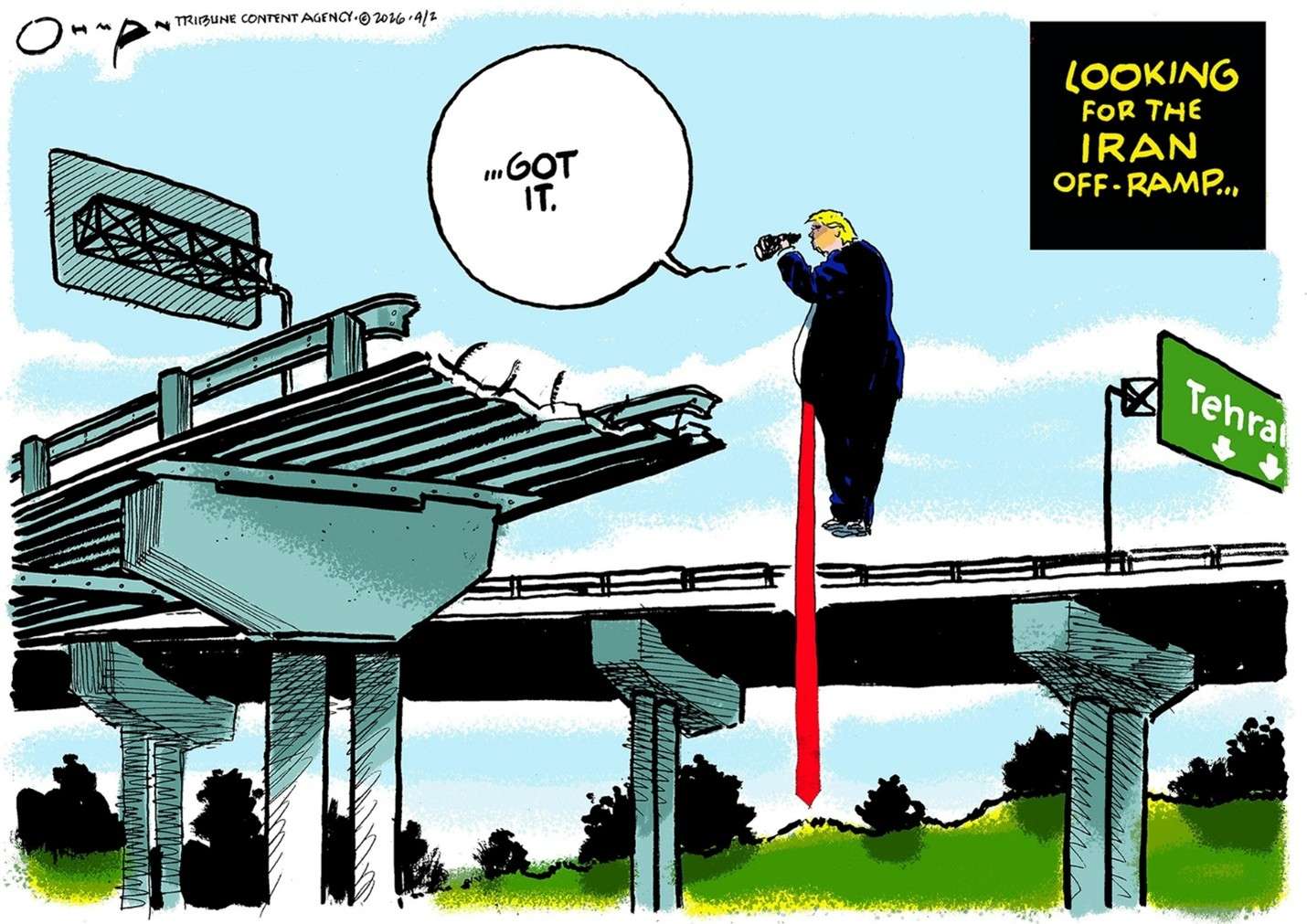
After 6 weeks of War, announcements this past week nevertheless are intended to imply that “peace is at hand.” A ceasefire (they say) has been agreed. Forthcoming discussions will lead to a negotiated settlement where neither side will be a loser. That, too, is a misconception. A negotiated settlement requires a commonality of interests, a meeting of the minds, a pre-existing basis for discussion even if only with respect to minor details. Unfortunately, each party to the ceasefire has staked out a position in direct opposition to the other. President Trump reportedly has offered a 15-point proposal while Iran has proposed a 10-point plan. Neither is reconcilable with the other, although President Trump unsurprisingly has described the 2 plans as forming a “workable basis” for settlement. Yet, Iran has not ceased firing missiles and drones at its neighbors, America and Israel have not ceased bombings, and the Strait of Hormuz remains closed…, with Iran’s foreign minister reiterating that “safe passage through the Strait of Hormuz will be possible [only] via coordination with Iran’s Armed Forces and with due consideration of technical limitations.”
Where does that leave the warring parties?
Anyone who believes that there can be a “winner” of the War is suffering from “Trump Delusion Syndrome” or “MAGA Delusion Syndrome.” Although it is true that Iran’s Theocracy has lost more than it has gained, it has not been the “loser” in the conflict and America has not been the “winner.” The Theocracy remains in control of the Strait of Hormuz, retains whatever fissionable material survived the 12-day June war, and has preserved its stranglehold on the Iranian populace despite America’s and Israel’s best efforts. These are significant accomplishments. In addition, the ceasefire allows Iran at least 2 weeks during which it will make more missiles and drones, profit from the shipment of more Iranian oil, and receive further aid from China and Russia. The status quo therefore leaves America with two choices. Either President Trump must do what he promised he would not do – involve America in a potential “forever war” by putting boots on the ground (on Kharg Island, in the areas adjacent to the Strait of Hormuz and/or surrounding Iran’s buried nuclear stockpile) –, or reconcile America to the current ceasefire stalemate. Assuming that the Theocrats indeed allow traffic to flow through the Strait and that the U.S. and Israel refrain from further bombings, talks can continue for quite some time, perhaps indefinitely. Such an outcome would be welcomed by the Theocracy. The Theocrats (along with the IRGC and Basiq) thereby would remain atop the Islamic Republic, benefiting from ongoing sales of Iranian oil (gas and fertilizer (and helium)), and retaining the threat of someday digging out its nuclear stockpile. As long as the Theocrats are agreeable to parsing the wording of any such “negotiated ceasefire settlement” in non-TACO language acceptable to President Trump, the U.S. could trumpet America’s and Israel’s military success in re-opening the Strait, destroying the Theocracy’s navy, missile launchers, and much of its defense industrial base, decapitating its political and military leadership, fatally damaging its nuclear program, and eliminating the threats from Iran’s proxies, particularly Hezbollah in Lebanon. All of this at the same time as America will have brought the Arab Middle East closer to Israel, the Abraham Accords, and a new diplomatic alignment in a Trump-defined world order.
However, as TLR concluded at the War’s beginning, the absence of a clear “winner” nevertheless is likely to lead to further geopolitical and economic chaos.
TLR (yet again) awaits further developments.
Finally (from a good friend)



No Comments