


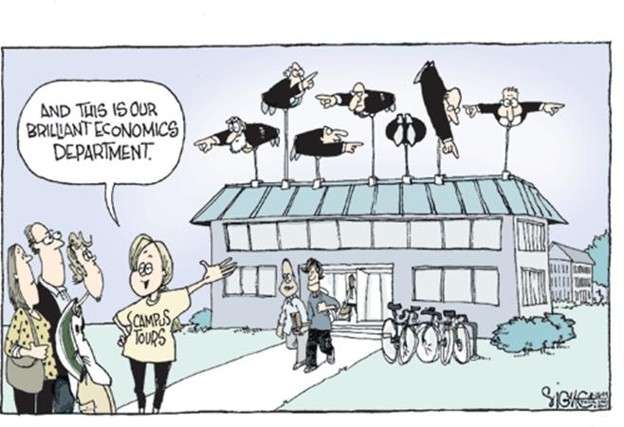
19 Sep Modern Monetary Theory Is Working!
“Can MMT continue to work indefinitely?” – The Lonely Realist
The naysayers who have derided Modern Monetary Theory as a fringe political ideology lacking in economic substance should acknowledge that MMT has been working quite well. The U.S. has been printing virtually limitless Dollars and successfully deploying those Dollars to drive growth and fund escalating deficit spending – currently running ~$2 trillion/year. MMT supporters argue that it can continue doing so indefinitely because the U.S. can never run out of Dollars – America does, after all, own the Dollar printing press. And it is clear that Dollar printing has boosted economic performance: America’s GDP has been growing at >2%/year for the past >15 years – the period during which money-printing has accelerated – and America’s economy has been the world’s best. Some even contend that MMT’s success means that good economic times can last forever, that the economic benefits of MMT need never stop working.
The foundational claim for MMT is that a government cannot run out of its own money (as Stephanie Kelton argues in her book, “The Deficit Myth”). As a consequence of pursuing MMT policies, America therefore is capable of “building a more just economy that works for the many and not just the few,” meaning that America can finance virtually anything, for example by issuing Dollar-denominated debt and using its printing press to pay the interest and, just as easily, print more Dollars to retire the debt. This perpetual motion Dollar machine works not only because the U.S. government owns the printing press, but also because the Dollar is the world’s reserve currency, the U.S. has the world’s largest and most durable economy, and the Dollar is backed by the largest quantity of gold held by any country. The U.S. therefore has the capacity to spend far more than it historically has. Why shouldn’t it do so? What, after all, could force it to stop? Unlike an individual borrower, the U.S. can’t spend too much and can’t have too much debt. Massive national debt and deficits haven’t mattered to-date, so why should they matter going forward? Government spending has increased and can continue to increase to ever-higher levels to fund defense, health care, a universal basic income, universal higher education, and jobs for everyone. Public expenditures of any size and duration accordingly can be financed through money creation without the need to increase taxes or limit spending.
Yet there are credible dissenters who fear that the outcome ordained by Stein’s Law awaits – they believe that nothing, and certainly not MMT, can go on forever. As Paul Ryan observed in 2011 in commenting on America’s debt and deficits, “We are headed for the most predictable economic crisis in history.” Former Senator Ryan was >15 years too early. And he was not alone: Larry Fink labeled MMT “garbage.” Bill Gates called it “crazy talk.” Jeffrey Gundlach said that it’s “complete nonsense.” Former New York Fed president Bill Dudley called it a “crackpot theory.” Larry Summers called it “fallacious at multiple levels.” Liberal economist Paul Krugman has rejected the economics underlying MMT. And former Fed Chair Jay Powell called it just “wrong.” The concern voiced by Ryan and others is based on the reality that massive debt and deficits inevitably lead to inflation and create economic and geopolitical disconnects that destabilize the economy. Corrective measures include increasing taxes and reducing spending, which strangle economic activity and, if left unaddressed for too long, result in recession or worse.
TLR in April 2019 asked “Will Modern Monetary Theory Work?” and concluded that it would, that MMT would continue to power American economic growth for many years but that, as Stein’s Law foretells, at some point suddenly would stop. Such an ending will occur if/when there is a loss of faith in the value of the Dollar (for example, if foreigners at some point require a Dollar discount for payment of goods and services), or there is excessive inflation, or money printing ceases to boost the economy, none of which was threatening in 2019 and none of which appear imminent today. There currently are no challengers to Dollar hegemony, the Dollar is universally accepted as the world’s medium-of-exchange, inflation remains under control, and U.S. productivity and GDP growth continue to increase. Yet, it’s not hard to understand that the concept of a perpetual motion machine requires a great many unprecedented economic, political and social realities to continually harmonize to create an ideal economy – as Jeffrey Gundlach has noted, “It sounds good for a first-grader.” Nevertheless, printing more-and-more Dollars today appears not only to be a workable policy, but precisely the policy that the Trump Administration intends to pursue.
Over the past 25 years, America’s GDP has continued to grow (despite the 2008-09 Great Recession and the COVID pandemic), employment has increased, inflation has been held in check, and the Dollar has strengthened. That lends support to the assumptions underlying MMT … and for there to be continued deficit (fiscal and monetary) spending. Government expenditures, even those that create massive deficits, can increase a country’s wealth and productivity … if appropriately targeted. If those expenditures increase job opportunities and/or job creation, that will add to the country’s wealth by being recycled through the economy. If those expenditures increase Americans’ spending, that will have a multiplier effect by creating jobs and prompting further spending. If those expenditures lead to increased corporate research and development, that will create technology and a national competitive advantage, adding to the country’s wealth. If those expenditures cause companies to build new plants and put more equipment into service, that will add jobs and income. If those expenditures reduce environmental damage and incentivize new industry, that too will increase productivity as well as reduce health-care costs, create jobs and add to the country’s wealth. Unfortunately, those have not been the ways either Democrats or Republicans have been looking at or authorizing government expenditures. They have not been targeting productivity gains. Medicare for All has laudable goals, but putting more Americans to work and spurring consumer spending are not two of them. Republicans’ tax cuts and tariff and immigration policies have not resulted in increased R&D, the building of more plants or the purchase of additional equipment, instead fueling stock buy backs and greater demand for goods and services. Government expenditures that increase wealth and productivity will enable the U.S. to pay off the increased debt that those expenditures incur as well as finance further expenditures … for both parties’ purposes. If that does not happen, however, trouble lies ahead!
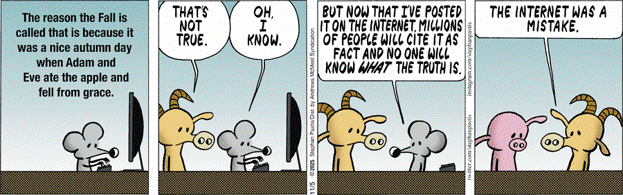
Finally (from a good friend)

No Comments