


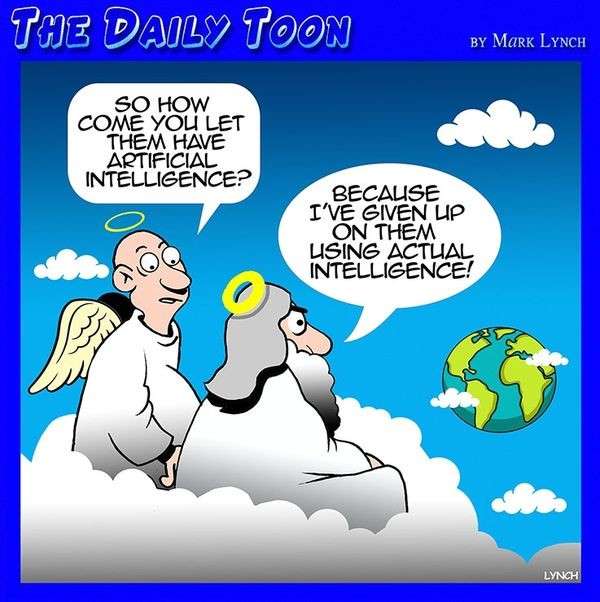
28 Feb The AI Revelation
“AI is coming for your job.” – The Lonely Realist
“And then will be coming for you.” – Cassandra
TLR recently had a thoughtful conversation about Artificial Intelligence with Cassandra, the mythical oracle TLR often consults about the future — noting, however, that although Cassandra at times has accurately predicted future events (notably, the Trojan Horse) and that her predictive powers derive from her relationship with the Greek god Apollo, she is not a goddess herself. She is an interpreter of portents, sifting data, discerning future probabilities, and using >2,000 years of experience to make often catastrophic predictions about the future.
TLR chose this week to discuss the impact of AI on the human condition because of the release earlier this month of Opus 4.6 by Anthropic and GPT 5.3-Codex by OpenAI. TLR understands that these releases demonstrate a surprisingly rapid acceleration in AI development, that this has led many to conclude that AI has “crossed the innovation chasm,” and that their release accordingly demarks an historic, truly revolutionary turning point in the human-AI relationship.
In brief, those who have analyzed Opus 4.6 and GPT 5.3-Codex believe that their release will eliminate the need for human coders and, consequently, will have a devastating economic profound impact on the software engineering industry. [ED NOT: That is, software engineering companies and their workers have been “Luddite-ed.”] As an AI insider explained in a widely-distributed post (“Something Big is Happening”), Opus 4.6 and GPT 5.3-Codex so greatly simplify coding tasks that anyone now can create complex programs without having a coding background. What is necessary, the author says, is to “describe what I want built, in plain English, and it just… appears. Not a rough draft I need to fix. The finished thing. I tell the AI what I want, walk away from my computer for four hours, and come back to find the work done. Done well, done better than I would have done it myself, with no corrections needed.” The conclusion he reaches is that the significance of Opus 4.6 and GPT 5.3-Codex and the impact of AI on human workers no longer can be overlooked. The release of Opus 4.6 and GPT 5.3-Codex represents more than a mere improvement over earlier AI programs. The two are “making intelligent decisions” about how to code, OpenAI stating that “GPT 5.3-Codex is our first model that was instrumental in creating itself…. [It] debugged its own training, managed its own deployment, and diagnosed test results and evaluations.” Opus 4.6 and GPT 5.3 accordingly already have reduced and, in time, will virtually eliminate the jobs of human software developers. Their next versions – presumably Opus 4.7 and GPT 5.4-Codex – will build smarter and more efficient code-writing versions of themselves (and of everything else) since “making AI great at coding…unlocks everything.” Unsurprisingly, the release of Opus 4.6 and GPT 5.3 had an immediate economic impact on the industry, reducing the value of software service firms and of creditors of software firms. What this makes apparent is that other knowledge-based industries are destined for similar disruption…, and soon. Those industries already are targets of Anthropic, OpenAI and their peers…, as well as of those who will be using Opus 4.6 and GPT 5.3-Codex to write their own code. “The experience that tech workers have had … of watching AI go from ‘helpful tool’ to ‘does my job better than I do,’ is the experience everyone else is about to have.” The other knowledge-based industries that accordingly are about to be “Luddite-ed” include medicine, law, accounting, architecture, teaching (including by parents), marketing, writing (of fiction, non-fiction, and music), financial services, scientific (and other) research, data collection and aggregation, and knowledge-based businesses operating in all other nocks and crannies of the economy.
Cassandra readily acknowledges the immediacy of the coming AI transformation. However, she foresees further consequences for humanity. She does not believe in the AI take-over scenarios popularized in The Terminator and Matrix series. Nor does she subscribe to fearmongering surveys that conclude that AI will lead to human extinction or irreversible global catastrophe (such as where 50% of surveyed AI researchers predicted a 10% or greater chance of humans becoming extinct from uncontrollable AI). Noting that Opus 4.6 and GPT 5.3 already are in the process of replacing human coders, she predicts a rapid acceleration in AI revolutionary replacement-and-displacement, with wave-after-wave of innovation swamping America’s highly-educated workforce. The revolution will take only a handful of years…, in sharp contrast to the 19th Century’s industrial revolution where workers (and society) had many decades to adjust. The speed of change will mean that 21st Century workers will be unable to make needed adjustments. She predicts that the slogan of “We will not be replaced” soon will become the chant of knowledge-based workers whose jobs no longer exist and whose skills no longer benefit society. Today’s 20th Century entitlement shock absorbers were not designed to address the coming 21st Century dislocations…, and will be hampered by America’s excessive deficits, debt and divisions. The outcome she sees is an AI-sparked “revolution.”
Cassandra, however, foresees even more significant consequences, predicting a new stage of AI-human evolution. She points out that life on Earth began with inorganic matter evolving into the organic. She expects the next step in evolution to be the integration of homo sapiens and AI to create the best of the organic and the AI technological and result in a hybrid “species” of increased intelligence and capabilities, perhaps one that resembles the Neo character in The Matrix. Knowledge necessarily will become ubiquitous. Everyone will have increasingly greater capabilities.
It may be that Cassandra’s combination of AI revolutionary change and evolutionary Neo-ism will come to pass. Or perhaps Dario Amodei’s dream of a technological future centered on “Machines of Loving Grace” will be the next stage. There remains the possibility, as well, that AI will turn out to be the existential calamity feared by atomic scientists (e.g., nuclear Armageddon) or science fiction doomsdayers (picture “The Borg”). The one certainty, however, is that AI represents a revelation that will usher in massive change…, and far more quickly than people have been expecting.
Finally (from a good friend)


jeffcsiegel
Posted at 17:33h, 01 MarchSpeaking as a software developer I don’t draw the same conclusion.
Claude gives slightly more intelligent results than GPT, but there are limits. The tools are good but nothing like they claim. This year it has given a 25% performance boost to software developers which is not catastrophic. Unlike most fields, for the last 30 years, productivity improvements have hit software development every year, so while this is impactful, it isn’t far out of the ordinary. The tools can sometimes do 90% of the job quite impressively and people are fooled into thinking that is all there is to it. There is a huge difference from 90% to the 100% we need for a real product.
People are over estimating the impact of these tools on employment in a couple of ways. First software developers and engineers don’t spend all their time doing deep level development. In the past I’ve seen estimates as low 10% of their time is in this core area. If 10% of your job got 50% better, do they still need you? If as a lawyer you don’t have to transcribe meeting notes and calls anymore because an AI agent does it for you, does that mean you aren’t needed? Maybe your secretary is less valuable and can be shared across more people, but I don’t think it removes the lawyer from the picture. And second, there is a lot of skill involved in getting the requirements of software correct, the testing really complete, and the operations both reliable and cost effective. That will continue to require software developers. Perhaps less of them, but again it won’t really replace them.
For these reasons, I think the impact to the greater economy will be much less than feared.