


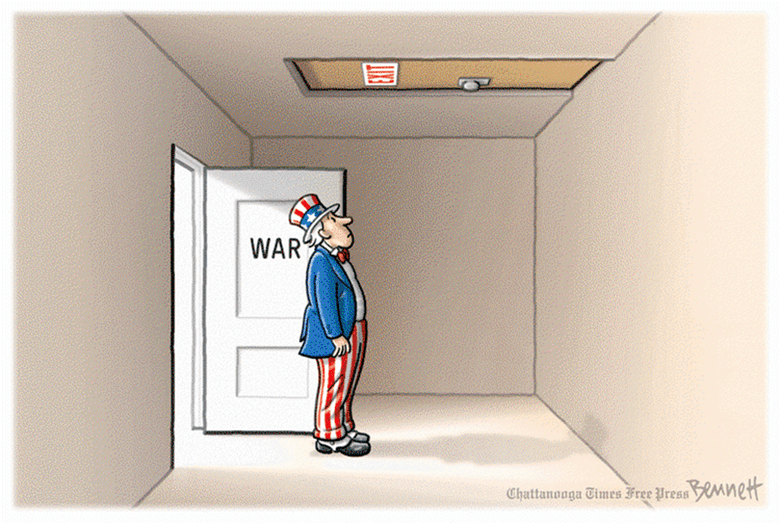
21 Mar The Economics of War – Part 2
“Wars are messy, their consequences unpredictable.” – The Lonely Realist
“The implications of developments in the Middle East for the US economy are uncertain.” – Jerome Powell (March 18, 2026)
History teaches that wars are disruptive. They have unanticipated spillover effects, including by creating interest rate and stock market instability. Their economic and geopolitical consequences spiral and expand…, especially if they don’t go as planned.
The seemingly sudden onset of the Iran War surprised observers. After all, it was only last June when the U.S. and Israel bombed Iran’s nuclear facilities that President Trump declared that “Iran’s key nuclear enrichment facilities have been completely and totally obliterated,” concluding that the attack had been “a spectacular military success.” Yet Iran apparently retains ~970 pounds (441 kilograms) of highly-enriched uranium that it can use to produce 11 nuclear weapons. That led America and Israel to go to War. Iran, however, was prepared. It had accelerated its nuclear and missile programs, solidified external support from Russia, China and others, and adopted a diffuse IRGC command-and-control strategy capable of choking global energy transport. As a result, the Iran War now is “The Oil War” or “The Strait of Hormuz War” (as well, perhaps, as “An Inflation/Stagflation/Recession War” and “US Dollar War”).
After three weeks of War, Iran’s thus-far successful closing of the Strait of Hormuz has been the biggest shock to oil supply in history. While the effect on U.S. consumers has been muted by America’s plentiful oil and gas production, the global shock has pushed up energy prices everywhere, particularly for India, China, Japan and South Korea which, combined, account for ~70% of Hormuz crude oil shipments. This spike in oil prices will not be short-lived. Moreover, the longer the War, the greater the price volatility…, and its consequences. The currently planned 400m barrel release of oil reserves by the International Energy Agency may or may not hold down prices for the short-term, but will create long-term price increases based, in part, on the depletion of those reserves…, and they started out lower than they should have. The worldwide economic impact of the oil shock already has reduced investment and employment. However, it has not yet affected inflation expectations, interest rates or stock market prices. In addition, and against all expectations, the US Dollar has been strengthening. The Iran War’s economic effects therefore have been precisely the opposite of those sought by the Trump Administration – that is, for a weaker Dollar, lower interest rates, cheaper oil and gas, and a strong stock market.
Some have questioned the Administration’s apparent lack of planning. They note that the Biden Administration had released 180 million barrels of oil from America’s Strategic Petroleum Reserve (SPR) in a politically motivated move that stabilized prices. Those releases bled the SPR to its lowest level since 1983. The Biden Administration made no effort thereafter to restore reserves despite having economically favorable opportunities to do so (a failure criticized by TLR). Critics argue that the Trump Administration should have planned for the Iran Oil Shock by topping off the SPR as a prelude to launching the War. The Trump Administration also has been faulted for its decision to decommission four of America’s minesweepers, enhancing Iran’s ability to successfully plant mines in the Strait of Hormuz. Criticisms abound. Yet the War is barely three weeks old and, although its outcome and consequences remain perilous unclear, U.S. and Israeli efforts appear to have achieved a high level of success (“the degradation of the Islamic Republic as a military and nuclear power has been enormous and is likely irreversible”)…, though victory (however defined) requires a longer-term perspective.
An evaluation of the economic impact of the Iran War therefore is elusive, clouded (among other things) by the fog of war. What is clear is that there will be energy price and inflation increases for at least the next several months, GDP will slow and, because there will be increasing unemployment, the economy will soften. These near-term economic consequences will be driven less by the reported “facts” than by the uncertainties. Despite concerns, America’s publicly-traded companies have indicated that they will report strong earnings growth, improved manufacturing numbers, low unemployment claims, and increased consumer spending. If so (and, by their actions, investors have expressed skepticism), stock prices are likely to remain range-bound.
A concern expressed by skeptics is that the AI revolution, climate change, tariff wars, America’s debt and deficits, the Iran War (including its environmental impact) and an abrupt end to the U.S.-led “rules-based world order” will have a domino effect that leads to imminent upheaval. A reader recently highlighted the existential nature of that threat by quoting from Carl Sagan’s prescient 1995 book, “The Demon-Haunted World: Science as a Candle in the Dark”: “I have a foreboding of an America in my children’s or grandchildren’s time – when the United States is a service and information economy; when nearly all the manufacturing industries have slipped away to other countries; when awesome technological powers are in the hands of a very few, and no one representing the public interest can even grasp the issues; when the people have lost the ability to set their own agendas or knowledgeably question those in authority; when, clutching our crystals and nervously consulting our horoscopes, our critical faculties in decline, unable to distinguish between what feels good and what’s true, we slide, almost without noticing, back into superstition and darkness…. The dumbing down of America is most evident in the slow decay of substantive content in the enormously influential media, the 30 second sound bites (now down to 10 seconds or less), lowest common denominator programming, credulous presentations on pseudoscience and superstition, but especially a kind of celebration of ignorance.” Cycle theorists (e.g., Ray Dalio, John Mauldin) believe that we are approaching the end of a “Big Cycle,” the tipping point feared by Sagan…, and that the Iran War could be the tipper (Ray Dalio recently stating the following: “When the world’s dominant power that has the world’s reserve currency is overextended financially, and it reveals its weakness by losing both military and financial control, watch out for allies and creditors losing confidence, the loss of its reserve currency status, the selling of its debt assets, and the weakening of its currency, especially relative to gold.”).
TLR awaits further developments.
Finally (from a good friend)
No Comments