


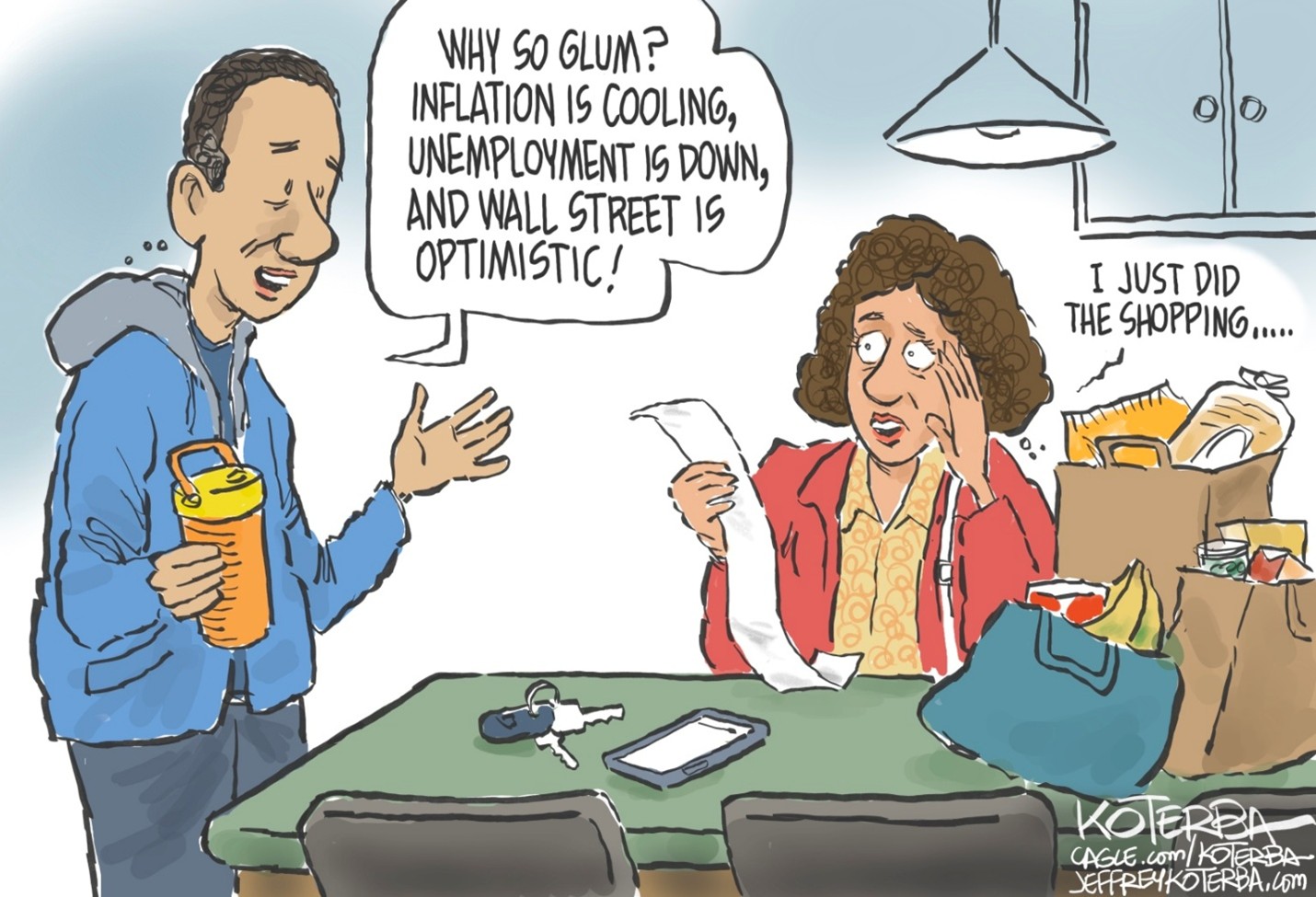
31 Jan “There is no Inflation…, unless you go shopping”
“That’s a quote from a reader. Government numbers are confusing. Can they be reconciled?” – The Lonely Realist
The recent inflation data released by America’s Bureau of Labor Statistics (BLS) was tame. The Consumer Price Index (CPI) rose by 0.3% in December (following similar numbers for November, October and September), which means that reported inflation for 2025 was 2.7%. That inflation rate is an improvement over both analysts’ estimates of 3.2% and 2024’s inflation rate of 2.9%. Yet a lower rate of inflation is not what Americans are experiencing. Food prices for groceries and at restaurants are uniformly higher, increasing 0.7% from November to December, and coffee and beef in 2025 posted inflation rates of approximately 20% and 16%, respectively. Similarly, residential electricity rates in 2025 rose by >5% and average natural gas prices increased by >4%. Consumer prices are expected to rise even faster in 2026. The fact is that prices of “necessaries” are rising at faster rates than those of luxuries…, meaning that lower-income Americans are feeling the pain of inflation far more than their wealthy cousins.
The story is similar with respect to unemployment. The BLS in January reported that the U.S. added 50,000 jobs in December, meaning that the economy currently has a 4.4% unemployment rate, which is both healthy and historically strong. The data nevertheless suggest a slowing labor market, with weakness in construction, retail, and manufacturing – strength in health care and hospitality accounts for almost all private-sector job growth. Moreover, although the U.S. economy added more than 500,000 new jobs during 2025, evidence of expanding layoffs at some of America’s more significant public companies, including Amazon, suggests that troubling labor market developments may lie ahead.
America’s Bureau of Economic Analysis (BEA) reported strong economic growth as part of a rebound from April’s Liberation Day. Its January 22nd release stated that the U.S. economy grew at an annual rate of 4.4% during the 3rd quarter which followed an increase of 3.8% for the 2nd. Both increases were driven by strong consumer spending on services and goods, increased exports and copious government spending. GDP growth for all of 2025 therefore is expected to be ~3.2%, an increase over 2024’s 2.8% growth and well in excess of analysts’ expectations for a 2.3% annual GDP growth rate.
The combination of strong economic reports from the BLS and BEA and a roaring bull market in equities apparently isn’t being felt by the general public. In a January 27th release, the Conference Board reported that consumer confidence declined sharply in January, hitting its lowest level since 2014. Americans’ short-term expectations for income, business conditions and the job market tumbled by 15% to well below the level some analysts believe signals an imminent recession. Consumers’ assessments of their current economic situation hit a similar slide, declining by 9.9 points. “Confidence collapsed in January, as consumer concerns about both the present situation and expectations for the future deepened,” said Dana Peterson, the Conference Board’s chief economist. “All five components of the index deteriorated.”
So, is America’s economy on the rise or in decline?
The fact that the Federal Reserve is unconcerned suggests a healthy U.S. economy for 2026. The Fed left interest rates unchanged at last week’s meeting and provided no negative steer for the future. It made no new adjustments to its balance sheet and provided no new projections or dot plots. The Fed had cut interest rates at its prior 3 meetings which, along with ending a short-lived period of Quantitative Tightening, had significantly eased concerns about excessively tight market conditions. The markets accordingly are optimistic about the anticipated impact of the fiscal boost promised by ongoing Federal government deficit spending and surging corporate profits. Wall Street is bullish about everything…, except, perhaps, inflationary increases, with Fed Chair Powell this week cautioning that prices are “elevated.”
How can the apparent conflicts between recent economic reports be reconciled?
You may recall that way back in August after a weak BLS jobs report, President Trump fired Erika McEntarfer, Commissioner of the BLS, accusing her of manipulating data for political reasons: “In my opinion, today’s Jobs Numbers were RIGGED in order to make the Republicans, and ME, look bad.” He promised Americans that inflation was lower and that growth was higher…, and he’s a President who keeps his promises. He thereafter appointed E.J. Antoni as BLS Commissioner, an economist known for his criticisms of government jobs data and prior statements about the need to alter agency data to fit political needs, but withdrew the nomination in the face of Republican Party pushback. The Deputy Commissioner, William Wiatrowski, who had served in the same role during President Trump’s first term, became the acting head. He has delivered on the President’s promises in each subsequent BLS report. Inflation therefore is “tame” and employment indeed is “healthy and historically strong.”
Whatever the accuracy of the BLS numbers, the BEA’s GDP numbers correctly describe 8 months of impressive economic growth…, and why not? There are, simultaneously, $2 trillion of annual deficits, tariff taxes that incentivize exports, Fed interest rate cuts from September-December of 75 basis points, mass deportations that necessarily create job openings, a war-time global economy, and a President whose goal is to increase growth through “State capitalism”…, all economic stimulants…, and all of which are inflationary. These are combining with the President’s policy of weakening the Dollar to make imports more expensive, which adds to inflationary pressures. The President expects further stimulus in 2026 via additional interest rates cuts, noting that “Jerome ‘Too Late’ Powell again refused to cut interest rates, even though he has absolutely no reason to keep them so high…. We should have a substantially lower rate now.” President Trump thereafter announced the appointment of Kevin Warsh to replace Powell as Fed Chair, stating that Walsh “will never let you down.”
The reader whose anecdotal observation is that “There is no inflation…, unless you go shopping” therefore frames an interesting perspective. Although there are inconsistencies between today’s GDP and inflation numbers, those inconsistencies exist in different contexts. Yet the same factors that are driving economic growth are exerting increasing pressure on inflation. Consumer inflation therefore is likely to broaden and deepen in 2026. That is what the government’s numbers mean.
Finally (from a good friend)

If you want to sacrifice the admiration of many men for the criticism of one, go ahead and get married. — Katherine Hepburn
No Comments