


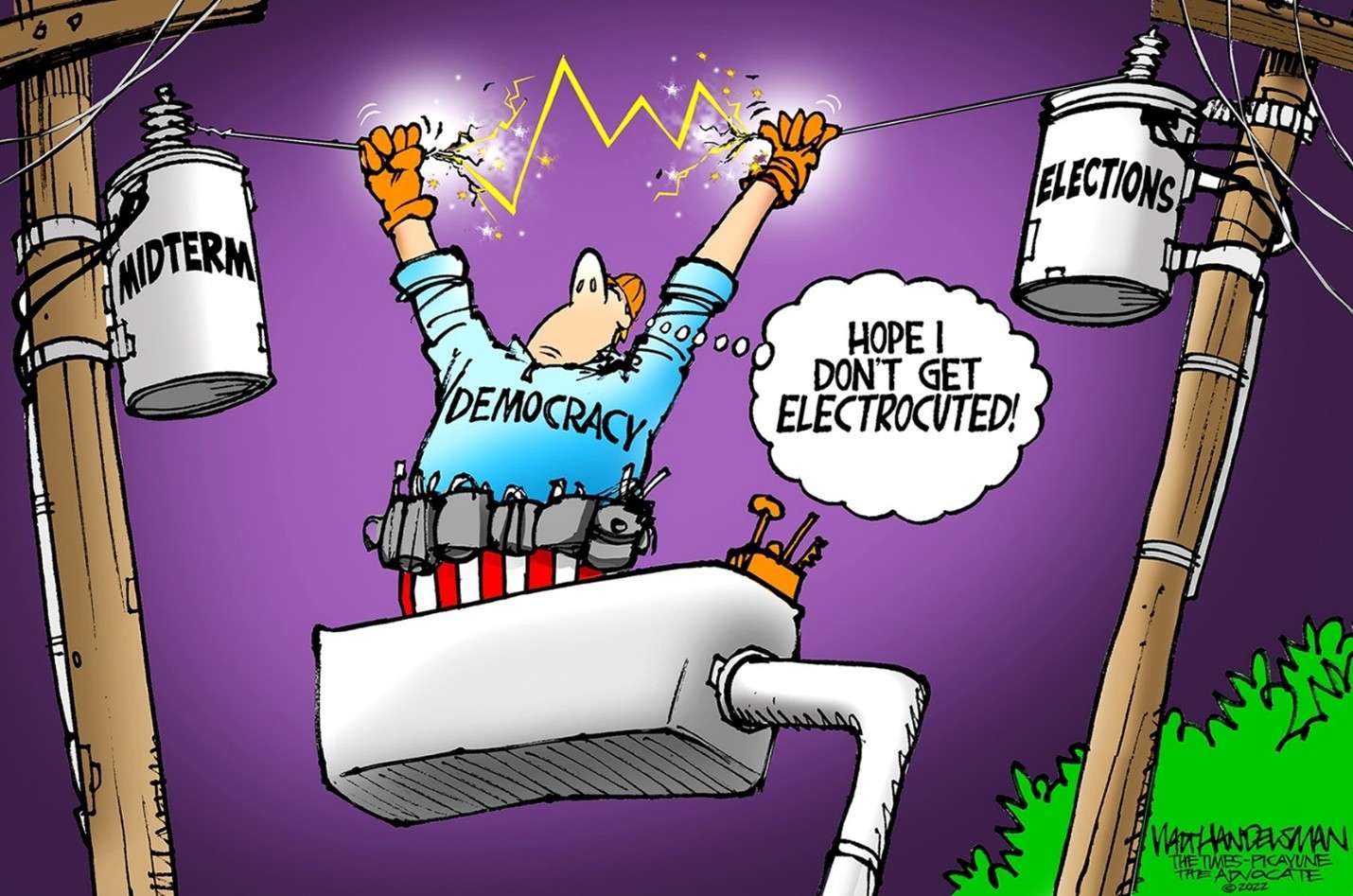
17 Jan Will America’s Midterm Elections be Fixed?
“The one thing that all Americans can agree on is that the midterm elections indeed will be ‘fixed.’” – The Lonely Realist
Although Americans will readily agree that the midterm elections will be fixed, they differ on what the term “fixed” means. “Fixed,” after all, has more than one definition. Which meaning applies to a given set of circumstances depends on a variety of factors and contexts. For example, one definition of “fixed” is “an end result that is not subject to change or fluctuation,” as in an outcome that recurs periodically. That definition would not apply to America’s midterm elections because significant changes occur from election-to-election. Sometimes one party is the winner and other times it’s the other party – that is, in America’s democracy, results necessarily vary as the political winds shift. Election results therefore are not “fixed” in this definitional sense and the midterms accordingly cannot be characterized as “fixed and determinable.”
A second definition applies primarily in linguistic and professional contexts, where “fixed” means “corrected,” as in something is “fixed” if errors are revealed and resolved, for example in repairing something that is broken or restoring something to working order that isn’t working properly. If America’s elections are “broken” in that they are malfunctioning and if the government will be repairing the broken electoral mechanisms, then, by definition, America’s midterm elections would require “fixing or repairing.” This raises the question of whether America’s electoral system indeed is broken. As noted below, evidence of such “breaks” is thin.
A third definition of “fixed” is the slang term where “fixed” means “rigged.” For example, an outcome is “fixed” if it is coerced or prearranged. Under this definition, the midterms would be “fixed” if the voting results were manipulated or if the outcome were to be achieved by force. If America’s election results will be engineered to achieve a targeted result, or if they are mandated by armed (or unarmed) force, they will be “fixed or rigged.”
Analysis of election realities necessarily begins with the theme pressed by President Trump that the 2020 Presidential election was “stolen” and that his loss to Joe Biden was “fixed” by the Democratic Party’s courting of illegal voters and counting of illegal votes in the swing States of Arizona, Georgia, Michigan, Nevada, Pennsylvania, and Wisconsin. (Online posts, all false, declared that “46 of 50 states have now recounted and CONFIRMED that Biden lost the vote in their state.” In actuality, all recounts confirmed Biden’s victory.) The President has pointed specifically to Fulton County, Georgia, where he claimed that massive irregularities in the vote-count had been engineered by Democrats, reiterating the argument he made in a January 2, 2021 phone conversation with Georgia Secretary of State Brad Raffensperger in which he called the Fulton County vote count “totally corrupt” and estimated that “250-300,000 ballots” had been “dropped mysteriously into the rolls.” Most recently, Georgia legislation enacted to provide the President with legal grounds to collect damages from Fulton County with respect to his dismissed indictment for election interference means that President Trump will recover $6.2 million for attorneys’ fees and litigation costs. Supporters have treated the legislation and his lawsuit as confirmation (and vindication) of President Trump’s rigging allegations, even though they’re not. Repetition, however, adds weight to supporters’ beliefs.
As one of his initial actions after being sworn in, President Trump issued an Executive Order directing Federal agencies to require documentary proof of citizenship, residency, etc., “to verify [voter] eligibility” and to also require absentee and mail-in ballots to be received no later than Election Day in order to be counted. He instructed the Attorney General to take enforcement action against States that include such ballots in their final vote tallies. In accordance with the Executive Order, the Justice Department has requested information from at least 43 States, including the last four digits of registered voters’ social security numbers, dates of birth and addresses. When 23 States and the District of Columbia refused to provide the requested information, the Justice Department sued asserting that the Federal government has the authority to require compliance, explaining that the “data is being screened for ineligible voter entries.” The Executive Order recently was blocked by a Federal judge, who ruled that the President lacks the authority to issue such an Order. The Administration has vowed to appeal.
Which definition of “fixes” are the ones described in the Executive Order? The Trump Administration contends that it is actively pursuing “corrections” to election ineligibility problems. Critics argue that these steps (together with gerrymandering and other measures) instead provide the means for “rigging” the midterm elections. Although they both may be right, each American’s conclusion is likely to be governed by which side of the political divide he or she supports…, and not by the facts.
Nevertheless, evidence as to whether America’s election mechanism requires “fixing” can be found in the conclusions reached by election studies analyzing the facts surrounding the 2020 election claims made by Candidate Trump (noting that judges who heard the cases alleging electoral wrongdoing found that none existed). For example, in “Lost, Not Stolen,” eight prominent legal and political figures concluded that there was no credible evidence of election fraud that would have changed the 2020 election outcome in any single precinct or State, concluding that “We are most concerned that even after failing in more than 60 court cases to produce evidence of fraud or irregularities that would change the 2020 election results, the repetition of the false charges of a stolen election continues.” That same conclusion was reached by the Democracy and Polarization Lab at Stanford University in “An Evaluation of Fraud Claims from the 2020 Trump Election Contests,” stating that “All of the claims we evaluate fail to provide evidence of fraud or illegal voting [and] are riddled with errors, hampered by misunderstandings about how to analyze official voter records, and filled with confusion about basic statistical techniques and concepts.”
Will more valid election results be the consequence of Trump Administration efforts to eliminate mistimed mail-in ballots and delete voters from precinct ledgers where States’ data (received by the Department of Justice) fail to “match” Federal data? Will requiring Federally-mandated proofs of citizenship, residency, etc., “to verify [voter] eligibility” enhance election validation? Or, as President Trump said earlier this week when asked about the midterms, “when you think of it, we shouldn’t even have an election.” After all, he noted, the result would be that “If we don’t win the midterms…, I’ll get impeached.”
We will find out the answer on November 3rd.
Finally (from a good friend)
No Comments