


21 Feb Change Has Come To America
“America will never be the same.” – The Lonely Realist
Whether you’re a fan or a critic of Donald J. Trump, in the 12 short months of Trump 2.0, the President has accomplished every goal he set. He deserves further credit for successfully executing on his campaign promises. His policies have radically changed America. The hope is that doing so presages an American Renaissance. The fear is that the President has effected State Capture. Both may be true.
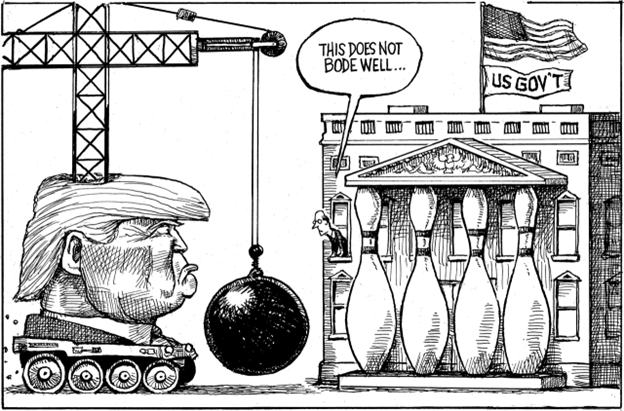
Whatever history’s judgment, the President has enjoyed stunning success. As TLR observed following his November 2024 election, Americans voted for disruptive change…, and that’s precisely what they’re getting. There have been fundamental, foundational shifts in America’s government, its domestic and foreign policies, and in the understanding of its Constitution. Although TLR forecasted the Trumpian changes, the speed and scope of Presidential accomplishments have exceeded expectations. In his first year in office, the President has adroitly expanded Presidential power and prerogatives, “trumped” Congress, sidelined America’s judiciary, and left allies and adversaries appalled astonished. America no longer has a moral center. All preferences, prejudices and hatreds have been given free rein, whether pro-semite, anti-semite, racist, religionist, replacer, or non-replacer. As long as you’re part of a constituent class that does not interfere with the government’s agenda, everything is acceptable. “Melting pot” is passé. “DEI” has been deleted from the dictionary…, as well as from private businesses, universities, law firms, media outlets and foreign entities hoping to do business with America’s government. “American Exceptionalism” now means “America First.” “Constitutional Rights,” once thought inviolate, are subject to the interpretation of America’s “Unitary Executive.” The President has issued >200 “Executive Orders,” making fiscal decisions in contravention of Congress’s “power of the purse” (found in Article I, Section 9, Clause 7 of the Constitution), withholding funding from Congressionally-mandated programs, reallocating Congressionally-budgeted expenditures to other uses (for example, pledging $10 billion to a newly-created Board of Peace), and ignoring Congressionally-enacted mandates (e.g., TikTok and the Epstein files). Republican members of Congress (and political appointees) understand that they hold office at the President’s pleasure and therefore willingly accede to his demands decisions. Appointees to the Federal Reserve are starting to believe that as well. Moreover, America’s judiciary can freely decide whatever it pleases, but it cannot enforce its rulings, the President following the precedent set by Andrew Jackson: courts can reach decisions, but “let them enforce it.” The Dollar no longer needs to enjoy its “Exorbitant Privilege.” “Globalization” is over. American might makes right. “NATO” and “Iran” are four-letter words.
Change has come to America…, and to the world. Those changes are here to stay.
The President’s policies often include prioritizing centralized government management over free market capitalism by deploying Statist policy-making to take Presidential control of selected industries, and exercising Unitary Executive Power to cow domestic and foreign media, law firms, universities, and private businesses. From a Constitutional perspective, the President has challenged limitations on personal profiteering under the emoluments clause (Article I, Section 9, Clause 8 of the Constitution), disputed immigrants’ right to birthright citizenship (under the Fourteenth Amendment), empowered Immigration and Customs Enforcement to serve as a Federal police force and the Department of Homeland Security to obstruct the media (in violation of the First Amendment), curb the right of Americans to carry guns to demonstrations that devolve into riots (in violation of the Second Amendment), engage in warrantless searches and seizures (in violation of the Fourth Amendment), and ignore habeas corpus for those it labels “criminal illegals.” President Trump has closed America’s borders to both legal and illegal immigration (discounting the risk that such actions may damage America’s economy) while reducing the flow of fentanyl into America (a trade-off favored by many Americans). As Unitary Executive, the President has launched lawsuits against the media, those who are unenthusiastic about his policies, and government agencies with which he can reach “consensual” settlement agreements. Change indeed!
Although the President initially took a “small government” approach by directing DOGE to pare the Federal bureaucracy, the methods employed were controversial and the results largely unsuccessful. Thereafter, however, the Administration’s actions reduced the number of government employees by >300,000.
Tariffs have been a policy cornerstone of Trump 2.0. Liberation Day was followed by on-again, off-again retractions, expansions, pressure tactics, negotiations, etc., with rates this past week 10-16% higher than on January 20, 2025. Although tariff collections totaled $194.9 billion, a recent analysis found that “nearly 90 percent of the tariffs’ economic burden fell on U.S. firms and consumers,” a conclusion contested by the Administration. A Penn-Wharton study concludes that if refunds are required following this week’s Supreme Court ruling that the tariffs are unConstitutional (explained here), they would offset almost all previously-collected tariff revenue.
The President has made significant changes to America’s fiscal and monetary policies, promoting cryptocurrencies, stablecoins, a weaker Dollar, and tariffs designed to increase exports and attract foreign investment. His OBBBA substantially reduced taxes (and increased America’s deficits and debt). Nevertheless, as Attorney General Pam Bondi stated during recent Congressional testimony: “The Dow is over 50,000 right now, the S&P at almost 7,000, the Nasdaq is smashing records, [and] Americans’ 401(k)s and retirement savings are booming.” Analysts have cautioned, however, that the President’s policies should have “set up the stock market for great things. But it’s not happening…. The S&P 500 has gained 14% since election day. That’s the weakest start to a presidential term in decades. The stock market was doing better at this point in both Obama terms, and Joe Biden’s, and Trump 1.0.” Other analysts have pointed out that “Based on labor market conditions, most industries were in recession for most of 2025.” The data, in short, are mixed. However, while it’s true that America’s economy indeed has been doing well, it is not booming and, in fact, has been underperforming virtually every other developed and developing economy.
The President also is seeking to change the way elections are conducted by seeking to impose a Federal mandate for proof of citizenship (for which the Constitution mandates Congressional approval) and has demanded that States provide the Federal government with voter rolls. The Administration has said that it is seeking “to root out non-citizens.” Critics say the goal is to “promote false claims about election fraud, target political opponents, or attempt to force states to remove voters from the rolls based on incomplete information.” [ED NOTE: The President has posted: “The Democrats refuse to vote for Voter I.D. or Citizenship. The reason is very simple—They want to continue to cheat in Elections. This was not what our Founders desired. I have searched the depths of Legal Arguments not yet articulated or vetted on this subject, and will be presenting an irrefutable one in the very near future. There will be Voter I.D. for the Midterm Elections, whether approved by Congress or not!”]
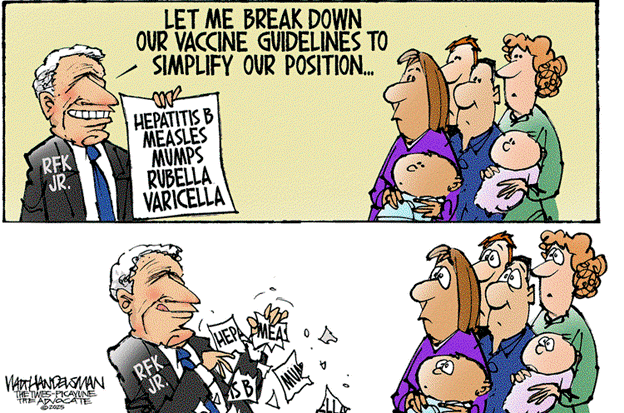
When it comes to American health, even more has changed. As The Economist recently observed: “Secretary of the Department of Health and Human Services Robert F. Kennedy, Jr., has made a punchbag of the Centers for Disease Control and Prevention, calling it the ‘most corrupt’ government agency. He has replaced the 17 members of its committee responsible for setting vaccination schedules and reconstituted it with vaccine sceptics. He has eliminated $1.2bn in federal grants to develop mRNA vaccines (a technology that [Trump 1.0] proved [was] wonderfully effective against covid).” But, then, Secretary Kennedy in a February 12th podcast explained why: “I’m not scared of a germ. I used to snort cocaine off of toilet seats.”
When it comes to foreign policy, TLR in 2019 had complained that, unlike Teddy Roosevelt, Trump 1.0 was speaking loudly and carrying a little stick. America, TLR later noted, has been paying a high price. Although Trump 2.0 continues to speak loudly, he now is carrying bigger sticks. He used one such stick against Iran in June 2025, another against Venezuela in January 2026, and today is threatening to use America’s biggest sticks to effect regime change in Iran. Although he has yet to resolve conflicts in Ukraine, Gaza, and Africa, impose further Donroe Doctrine discipline on Cuba, or resolve America’s differences with China (and Europe, India, etc.), he is making every effort to do so. Should he succeed, the Nobel Committee should rename the Peace Prize.
[ED NOTE: TLR has not enumerated the many additional Trump 2.0 disruptions that include wholesale and “for sale” pardons, climate change and environmental reversals, prioritizing oil, gas and coal over green energy, multiple institution and building name changes, “adjustments” to the United States, Mexico, Canada Agreement, as well as those discussed here and elsewhere.]
The cumulative disruptions of Trump 2.0 are historically unprecedented. Yet they comprise only 1 year of a 4-year term. Even more significant change lies ahead.
Finally (from a good friend)
No Comments