


04 Jul The Art of Inflation
“Modern economies have a love affair with inflation.” – The Lonely Realist
For some, inflation is a bad thing. For others, it’s a good thing. Whatever its impact, inflation is a modern fact of life and its future today seems … bright.
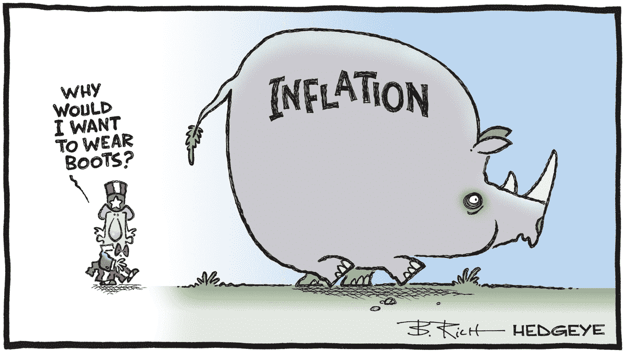
Inflation generally is viewed as a consumer phenomenon, although it has broader application. For consumers, inflation means an increase in the price of goods and services. When inflation occurs, buying power is reduced because Dollars (or Yen or Euros, etc.) buy less than they did in the past. This means that people need more money to purchase the exact same items, which creates a demand-supply imbalance. America’s Bureau of Labor Statistics uses its Consumer Price Index (CPI) to report the impact of that demand-supply imbalance and the CPI has become the widely-accepted (though not the only) yardstick for measuring the extent of inflation (noting that the CPI is an imperfect measure and that its recently-reported numbers may be suspect). Whether or not the CPI represents an accurate measure of inflation, there is no question but that America has been experiencing significant inflation. Reported CPI has risen by 28.5% since January 2020, which means that those who spent $100 on consumables 6-1/2 years ago can buy only $77.82 worth of those consumables today (with the cost of groceries reportedly rising even more, 37.9% between January 2020 and March 2026). The impact of inflation is even clearer when viewed over the last 113 years – that is, since the Federal Reserve was created in 1913 to “maintain price stability.” The value of a 1913 Dollar has declined by 97%. It now is worth only 3 cents. Inflation has made the repayment of all forms of debt, including mortgages, easier, and increased the price of homes. However, unless income increases at a higher rate, inflation creates widening wealth gaps…, and it has.
Textbooks say that inflation is driven by three primary factors: “demand-pull,” which is when demand for goods and services outpaces supply and does so for a sustained period of time; “cost-push,” which is when the cost/inputs of production (that is, materials and wages) increase, leading suppliers to raise prices for finished goods; and “inflation expectations,” which is when the public expects prices to continue rising and behaves by pushing up prices. A fourth factor is excessive money-printing, which is precisely what America’s government has been doing for the past ~25 years. When paired with Federal Reserve quantitative easing, the result is a Federal debt that now totals almost $40 trillion, an amount that continually increases because Federal deficits continue to run ~$2 trillion/year. The consequence is that America’s debt-to-GDP ratio now stands at 122.5%, a record high (and one that omits future obligations that increase the reality to >300%). Consumers have used this cascade of money-printing to pay for goods and services, the prices of which are rising because of inflationary “demand-pull.” It also has contributed to a 16-year bull market in equities. That excess money could have been used by Americans to reduce their indebtedness or increase their savings…, but that didn’t happen. The fact is that the money-printing via a combination of Federal deficit spending (fiscal policy) and Federal Reserve quantitative easing (monetary policy) led Americans on a spending spree and created today’s massive Federal debt and consequent inflationary pressures.
At the same time as deficits were adding to the national debt and the Federal Reserve was cutting interest rates, America’s equity markets were soaring. That’s no coincidence. Although analysts now are forecasting that new Fed Chair Kevin Warsh (seen by commentators as a monetary hawk) soon will be raising interest rates, equity markets have continued to soar. If a round of interest rate incrases truly lies ahead (with fiscal tightening by Congress completely off the table), bond markets should be bracing for tightening Fed actions. But they’re not. Perhaps that’s because Fed interest rate increases aren’t really in the cards…, and not only because the level of hawkish consensus today would lead a contrarian to view such an outcome with skepticism. It’s because President Trump has other priorities, and because he appointed Kevin Warsh to make those priorities a reality, it’s a good bet that he will do so. Those priorities include lower interest rates, a cheaper US Dollar, and an ever-rising stock market. Many question how the Fed can achieve all three without igniting further inflation. That is what Mr. Warsh should be expected to do.
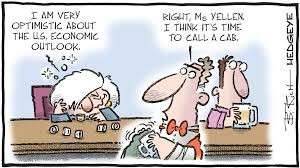
Mr. Warsh surprised analysts on Wednesday when he asserted that inflation is waning. He didn’t cite “demand-pull” or “cost-push,” but instead relied on “recent reports” that inflation expectations are diminishing (are they?). Although a thin reed, this is likely to be the first sign that lower interest rates lie ahead, prior to November. Although he didn’t mention other moderating inflationary factors, those factors exist and are likely to persist. They include Thursday’s “surprisingly” weak jobs report, that oil prices have dropped by >30% and seem headed even lower, that airline fares are not far behind, that AI will generate deflationary wage pressures, and that the inflationary impact of the Trump Tariffs is receding. Mr. Warsh also would have noted that the impact on CPI of the heavily-weighted Owners’ Equivalent Rent component is in a downward trend and is likely to have a disproportionally tempering effect on reported CPI (the obverse of its inflationary impact in prior years).
In order to realize the President’s goals, the Fed must simultaneously moderate consumer inflation and incentivize financial asset inflation, a challenging balancing act. To do so, the Fed soon will need to lower interest rates to reduce the cost of consumables, increase the attraction of equities, reduce the relative value of the Dollar (at the same time incentivizing exports, another Trump 2.0 priority), and bring down Federal financing costs that are an increasing percentage of America’s deficits. Can the Fed achieve its goals without increasing inflationary pressures? It has a number of monetary tools, one of which is its $6.7 trillion of bond holdings that could be allowed to run off and increase bond supplies, a form of monetary tightening. Mr. Warsh already has established task forces to examine Fed policy. A reasonable assumption is that a principal goal is to find ways to achieve the foregoing (noting that whatever direction is chosen, the outcome will be lower short-term rates). Inflation management today is an exercise in art[fulness].
The Lonely Realist now also can be found on Substack at https://substack.com/@thelonelyrealist?utm_source=global-search.
Finally (from a good friend)
No Comments