


27 Jun The End of Evolution
“Or a new beginning?”
“What is the evolutionary destiny of homo sapiens?” – The Lonely Realist
The question of humanity’s future has been the subject of intense philosophical discourse. Some believe they now have the answer.
The biblically-inclined have long believed in man’s afterlife, God’s reward for a virtuous life. They see homo sapiens as a creation of God and have faith that man’s terrestrial existence will end as the Bible describes (for example, in the books of Daniel and Revelation). They point to the Fermi Paradox as evidence of man’s unique place in God’s universe, the Paradox highlighting the contradiction between the incredibly high statistical probability of intelligent extraterrestrial life and the lack of evidence that any such life forms exist. Religious adherents accordingly are looking forward to Judgment Day, the “end of days” that will mark the beneficent end of the human experience heralding a Heaven on Earth. Some believe that Day is imminent.
Those who are scientifically-inclined foresee increasing human progress leading to enhanced intellectual capacity, longevity and perception. For many empiricists – and there are many in addition to Elon Musk – human progress will take homo sapiens to the planets and then the stars – to infinity and beyond! They reject that life on Earth is unique, noting that the Fermi Paradox has many possible explanations (with most empiricists favoring Einsteinian limitations on space travel coupled with Earth’s relatively remote location). Those who are more sci-fi-oriented have posited a variety of alternatives as well as a range of existential challenges that a humbled humanity may be required to overcome (prevailing even in such dark films as The Matrix and The Terminator as well as in Michael Crichton’s several books on the hazards of technology) to achieve progressively greater heights.
Today’s AI revolution, however, requires a rethink. Reality has reshaped the possibilities.
That’s because artificial intelligence has achieved far more, and far faster, than had been predicted. An example is Anthropic’s recent release of its Mythos 5 and Fable 5 models. The U.S. government on June 12th restricted their use based on the threat they pose to national security and private business code and information, which in turn led Anthropic to turn them off. That’s quite a turn of events given the President’s declaration only 6 months ago that “It is the policy of the United States to sustain and enhance the United States’ global AI dominance through a minimally burdensome national policy framework for AI.” That laissez-faire policy now is in tatters.
The concerns raised by Mythos/Fable nevertheless have not deterred AI developers from accelerating their efforts to produce ever higher-functioning AI models. Their goal (simultaneously (and competitively) in the U.S., China, Europe, the Middle East and elsewhere) is to create a technological simulacrum capable of using human thought processes and emotional insights to assume the responsibilities of both manual and knowledge-based human labor…, as well as to act as an infinite storehouse of human knowledge. Their efforts are intended to create a machine proxy (or proxies) for human beings – that is, an “artificial general intelligence” (AGI) – that replicates human functions and, accordingly, has the capability to replace homo sapiens. Is that the destiny of human evolution? If so, it places man’s future in man’s hands…, which does not mean that man is substituting himself for God. It appropriately may be viewed as a manifestation of God’s will, the intended “end of evolution” and the prelude to Heaven on Earth.
Since the beginning of recorded history, man’s progress has meant utilizing human-created tools to improve man’s existence. Just as man used the technological advances of the stone age (and of the agricultural, industrial and biotechnological revolutions) to improve the human lot, man now is using AI to do the same. AI, however, is a far more powerful revolutionary tool. Should it lead to the creation of AGI, it would not only contribute to an improvement in the human lot. It would significantly enhance homo sapiens, resulting in an evolutionary leap to “an improved technological model of homo sapiens,” a creation with human capabilities, yet with greater-than-human knowledge, greater-than-human thinking ability, and an innate ability to self-evolve/improve. That is more than mere progress. It is a higher level of existence.
AI may be on the cusp of perfecting a process called recursive self-improvement (RSI) in which AI writes and rewrites its own computer code, causing an intelligence explosion that, step-by-step, enhances its own abilities and eventually (which can be faster than experts previously thought) lead to superintelligence. Once an AI system achieves RSI, no further human input is needed in order for it to self-evolve/improve/”think.” As Jack Clark, a cofounder of Anthropic, has said, “What can seem to many like a fanciful story may instead be a real trend.” Indeed! Perhaps this is a vision that anticipates the outcomes in The Matrix/The Terminator or one that presages a machine-human partnership, a symbiotic relationship that exemplifies an evolutionary leap. Sci-fiers will recall The Borg from Star Trek, a technologically advanced species of cybernetic humanoids.
Whereas the agricultural, industrial, etc. “revolutions” had the effect of improving the human condition, the outcome of a beneficial AI revolution would be a technologically enhanced humanity imbedded in higher-functioning machines…, or, perhaps, an enhanced biological humanity partnering with higher-functioning machines. Among other things, AGI would be capable of downloading an individual’s memories and consciousness into an individual machine (perhaps through devices similar to those being developed by Neuralink), creating a [hopefully] benign doppelganger of its human counterpart. Technological doppelgangers, with their limitless access to knowledge and analysis, also would be immortal, enabling “technological man” to colonize the stars. Just as homo sapiens mooted the need for homo neanderthalensis, “homo machina” would moot the need for biologically-aged homo sapiens.
Commentators (including TLR) have raised concerns about the potential downsides of AI development, how AI could become humanity’s master. But what if AGI is the next step in human evolution? It has the potential to be a far more revolutionary improvement for homo sapiens than even the greatest of optimists had imagined. Would that be “The End of Evolution,” or “the realization of God’s plan”? We may be only a few years away from finding out.
The Lonely Realist now also can be found on Substack at https://substack.com/@thelonelyrealist?utm_source=global-search.
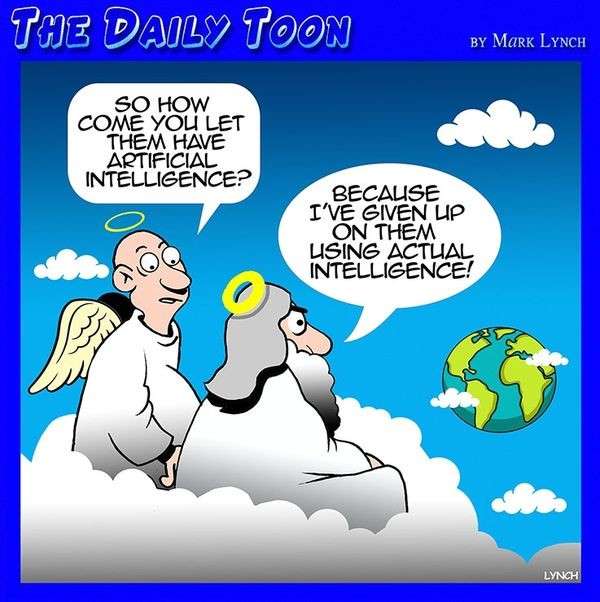
Finally (from a good friend)


singman siu
Posted at 10:00h, 29 Junethe probability distribution density function of human intelligence will be more and more spread out to log normal with mean towards to the right and higher and higher variance. It is AI…
Bob Fisher
Posted at 14:02h, 29 JuneWe can’t confront the effect of AGI on Homo sapiens evolution without agreeing.on what characteristics make us human. AGI can exceed human reasoning but it does not have moral or ethical agency. It depends on the data fed to it and is programmed mathematically. Empathy, meaning, moral ambiguity and new creative forms not based on works done before are beyond is powers. Of course this may change in the future.