


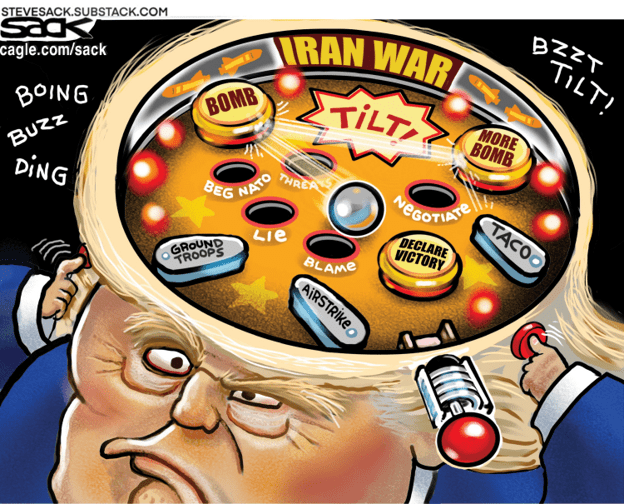
01 Aug An Iran War Solution
“How might President Trump successfully resolve the Iran War?” – The Lonely Realist
President Trump has offered various conflicting rationales for his decision to wage war on Iran, including that America was acting preemptively to prevent an imminent Iranian attack on Americans, achieve regime change, destroy Iran’s ballistic missile stockpiles, military infrastructure and naval assets, prevent Iran from acquiring nuclear weapons, and eliminate Iranian terrorist proxies from threatening Middle Eastern allies. None of those goals has been achieved and American intelligence agencies reportedly have told the President that none now is likely to be achieved. Even given “fog of war” cliches and Trumpian media obfuscations, it is clear that each Presidential rationale and each plan the President has pursued has been unsuccessful – that is, the Trump Administration’s Iran campaign has not survived the multiple punches delivered by Iran (borrowing Mike Tyson’s metaphor).
That is not an outcome acceptable to either the President or America, and not one that American voters are likely to relish. Moreover, neither the President, America nor America’s European and Asian allies believe that continuing the hostilities – that is, engaging in another “forever war” – will result in a satisfactory outcome. None has an appetite for a continued Strait of Hormuz blockade. And the world economic order would find it challenging to cope with an indefinite (or even an on-and-off) restriction of crude oil, fertilizer, helium, etc. exports from the Gulf or a closure of the Bab al-Mandab Strait by Iran’s Houthi proxies. Moreover, America’s Middle East supporters want to avoid further Iranian attacks on their most valued economic assets and minimize the risk of Iranian-inspired domestic unrest.
How then might the current impasse be resolved?
Interestingly, the Trump Administration may be pursuing a highly complex, multi-faceted resolution through a series of negotiations with strategically placed partners. At least, that is the hoped-for process [fingers crossed]. The Administration recently has publicized several American “sweetheart giveaway deals,” notably with Saudi Arabia, Turkey and the United Arab Emirates. Numerous critics, as well as Presidential supporters, have denounced those deals. Why, then, is the President pressing forward?
Superficially, the President would like to make economically and technologically beneficial deals for American businesses. But the President’s goals also include cementing Middle East alliances against Iran, deflecting Chinese influence, deepening the objectives of the Abraham Accords, defusing global (and American domestic) concerns about the plight of Gaza and Gazans, calming Americans’ anxieties about the Iran War, and bolstering America’s alliance with Israel. Needless to say, achievement of any of those goals, yet alone all of them, would require quite a high level of “sweetheart deal-making.”
Let’s start with the proposed nuclear deal with Saudi Arabia which sets out a framework for American businesses to export nuclear technology and build Saudi power plants to capitalize on that technology. There are any number of Saudi (and Congressional) prerequisites. Might one of those turn out to be a Saudi presence in Gaza and financial support to move Gazans out of Hamas-controlled areas? Might those Gazans then be provided with housing in “Saudi-controlled” bastions currently occupied by Israeli armed forces? And might those relocated Gazans become participants in Saudi-sponsored economic development? If that is part of the President’s plan, it would have much to recommend it.
If so, similar terms could be offered to others. The UAE previously agreed to forgo nuclear development, though only to the extent that the U.S. doesn’t offer favorable nuclear deals to other countries. The Trump Administration has done exactly that in making the offer to Saudi Arabia. Moreover, the Trump Administration on July 10th removed export controls on the UAE’s purchase of advanced AI chips. The UAE reportedly now is planning to buy 500,000 chips/year…, and Saudi Arabia, on which the U.S. previously had imposed similar export controls, is expected to purchase several hundred thousand of Nvidia’s most powerful AI chips. Quite a set of incentives, no? Both Egypt and Turkey have made similar requests. Both have been building nuclear reactors under contract with Rosatom, a Russian state-owned company. The U.S. now is in a position to offer terms similar to those agreed with Saudi Arabia (and the UAE). Moreover, the Trump Administration already has offered Turkey cutting edge jet engines and F-35 fighter jets. What might be the quid pro quo for such weaponry, nuclear technology sharing, and access to advanced AI chips? And then there are America’s recent trade and tariff discussions with Egypt. What might those discussions include that could have a favorable impact on the Gaza-Israel conflict?
A principal “cost” of a completed Saudi nuclear deal would be potentially limitless nuclear proliferation. Yet that could be an acceptable price for a successful Iran and Gaza outcome. After all, it could ensure global support for viewing the Iran War as a success, but only if it results in the creation of a (presumably Saudi-led) consortium that takes responsibility for sidelining Hamas and rebuilding Gaza, for strengthening Lebanon’s government and thereby undercutting Iran’s Hezbollah-terrorist proxy, for the consequent recognition of Israel’s right to exist (with an explicit rejection of “river to the sea”), and for both Israel and Palestinians seriously to address resolution of their issues. The world after all has already passed the nuclear proliferation tipping point, a reality made clear by the existing nuclear arsenals of Pakistan and North Korea. It now also is clear that, although America can delay Iran’s nuclear ambitions, it cannot prevent realization of those ambitions. Might this therefore be the time to encourage a Middle East rebalancing? A cojoining of the interests of Saudi Arabia, the UAE, Qatar, Turkey, Iraq, Egypt, Lebanon, Kuwait, Oman, Israel and others would enable them to leverage their common interests to stymy Iranian ambitions, serve as a beacon for Gazans, Lebanese, Syrians, Yemenis, etc., and pressure Iran into negotiations. Doing so would allow America to withdraw its military from the Middle East, ending American fears concerning another “forever war” and Middle East concerns about the spillover of great power rivalries. It could allow America to rebuild its munition stockpiles and depressurize the global oil and fertilizer markets (to the benefit of friends and fence-sitters alike) while weakening Russian and Chinese influence and satisfying President Trump’s domestic agenda.
Achieving those goals would require deft, simultaneous diplomatic initiatives on multiple fronts. But perhaps that’s what the Trump Administration already has begun doing. Should it all come together, the result would be monumentally historical, justifying far more than a mere Triumphal Arch.
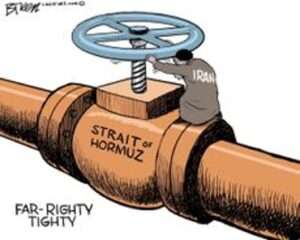
Finally (from a good friend)


No Comments