


31 Oct Demographics and Artificial Intelligence
“AI should be the antidote to America’s demographic decline.” – The Lonely Realist
“Demographics is destiny” is an economic axiom signifying that a population’s size, structure and composition significantly shape its future, including its economy, politics and social structure. An aging population (like Japan’s), low birth rates (like Europe’s), and a preference for male children over female children (like China’s) each has led (and continues to lead) to demonstrably adverse economic, geopolitical and social consequences.
America’s fertility rate at 1.57 births per woman (well below the 2.1 births needed for natural population replacement) is in decline, portending a decline in workforce that is being accelerated by an aging American population, restrictive American immigration policies, and global/economic shifts. As TLR wrote earlier this year, history shows that a downdraft in demographics is a warning sign of economic decline. As TLR highlighted, for America a declining population necessarily will pressure the viability of a number of America’s world-leading educational institutions and, if history is any guide, will also stunt business growth and contribute to the shredding of America’s social contract.
And yet, perhaps TLR’s concerns are outdated. Perhaps a purely demographic perspective, whatever its historical precedents, overweights the impact of “manpower.” Perhaps the more relevant lesson to be derived from history is that demographics is only one contributor, albeit an important one, to economic and military superiority and to their potential decline – that is, the more manpower, the greater the advantage, but the quantum of that advantage depends on how “manpower” is defined, how “manpower” is utilized and the amount of economic, social and other benefits contributed by non-manpower inputs. Technological innovation, for example, has provided quite a significant “edge” throughout history. In fact, the strategic application of economic and military technological strength has often overwhelmed superior “manpower.”
History teaches that nations achieve dominance because of how they leverage their relative advantages. Those advantages include not only the natural ones of location, resources, and population size. Success also depends on how effectively those advantages are utilized in the deployment of developing technologies. For example, in modern times, technological advances included steam power, electricity, transportation and communications (telegraph, telephone, internet), leading Britain to build a global empire in the 19th Century and the U.S. to become Britain’s successor in the 20th. Other countries with sizable populations fell behind. “Industrialization” provided an economic “edge” that allowed the enhanced utilization of both resources and workers. In ancient times, Alexander the Great, Attila the Hun and Genghis Khan used military and tactical innovations to gain their “edges”…, and used those “edges” to achieve dominance. For the Roman Empire, it was roads and aqueducts…, coupled with the tactical deployment of organized military force. For Britain, it was a superior industrial/mercantile policy and an innovatively designed and deployed naval fleet combined with a highly trained workforce. For 20th Century America, it was a potent combination of geographic and resource superiority, industrialization, education, superior transport and communications and a nuclear “edge”…, coupled with capitalist manpower.
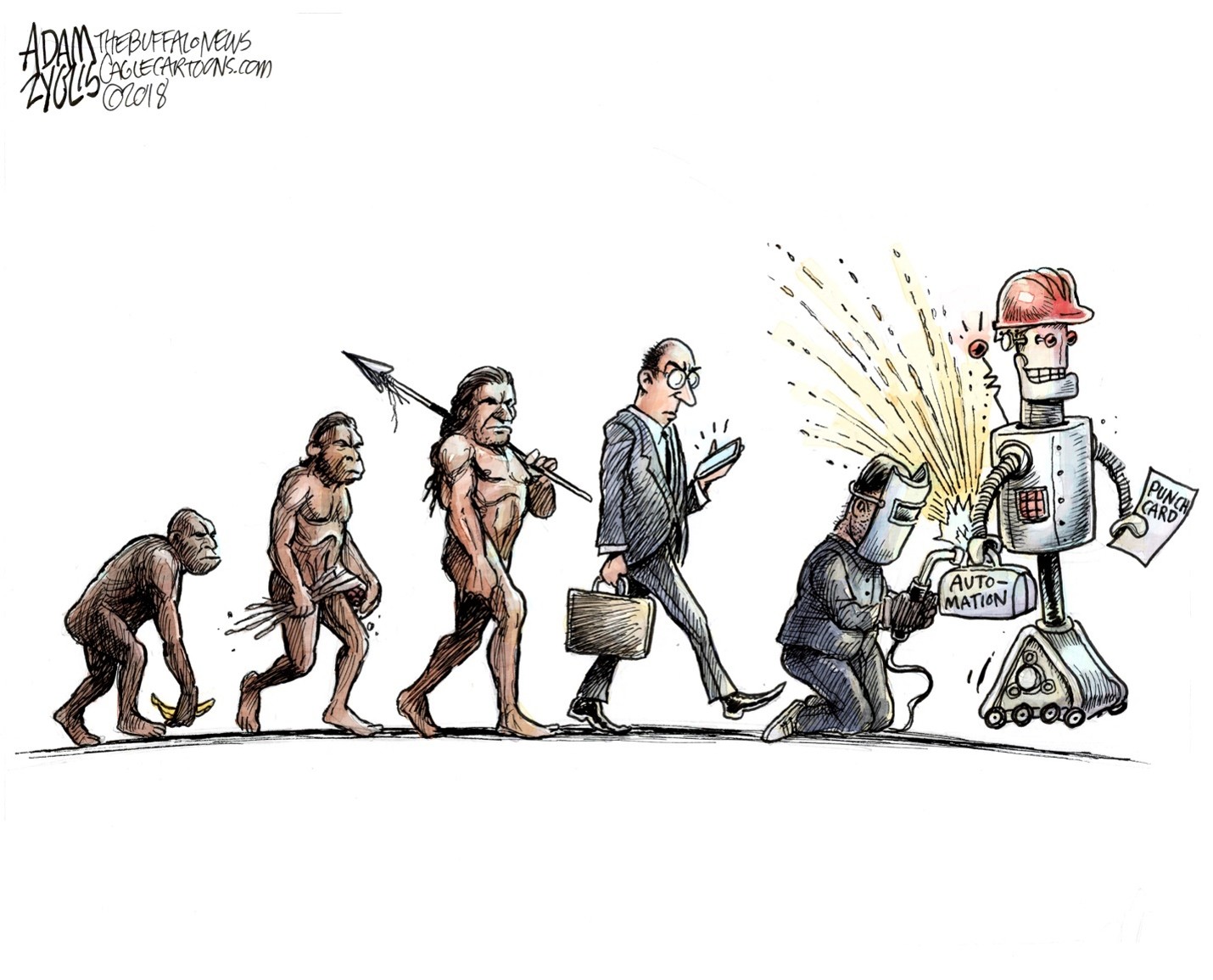
Artificial intelligence is emerging as today’s technological “edge,” having the potential to largely replace knowledge-based “manpower” through large language models and physical “manpower” through robotics. While the measure of “advantage” in the 19th Century was industrialization (and in ancient times military might), the measure of might making right in the 21st Century will depend largely on who builds and deploys the most effective AI. There are only two competitors in that AI race: America and China. Dominance in the 21st Century will be built on which of the U.S. and China builds the largest AI capacity, the biggest and most cutting-edge data centers, and the best AI applications and AI manufacturing capacity. It is those technological and industrial “edges,” and not demographics, that will determine power and success in the coming era.
BRICS+ and African nations are not players in the global AI race, nor is Europe. Europe’s focus continues to be on welfare statism with its emphasis on redistribution rather than investment and innovation. Per Marc Andreessen, “Europe seems determined to be left behind…. 25 years ago, if you did a list of the 50 biggest tech companies in the world, a pretty significant number were European…. Today you’re basically down to Spotify…. I think [Europeans] would be very happy if AI didn’t happen inside the EU.” And, although Israel and the UAE have been aggressive builders of their own brands of AI, they are far behind the U.S. and China and cannot compete with the buildout required by the global AI competition. As a consequence, the current state of global competition means that every country and every business outside of the U.S. and China will become dependent on one or both nations. Economic success soon will depend on which of the two competitors provides the better AI services, products and pricing.
Which brings into focus the possibility that China may have the greater competitive and military advantages. First and foremost is the risk, and the opportunity, presented by Taiwan Semiconductor Manufacturing Company Limited (TSMC), the world’s largest semiconductor manufacturer and the producer of ~70% of cutting-edge AI chips. Located a mere 90 miles from mainland China, TSMC in China’s view already “belongs” to China. TSMC therefore presents China with the ability to choke-off U.S. development of frontier AI models by choking-off TSMC, either militarily or economically. When combined with China’s laser-focus on global technology dominance, its cheap energy (and rapid construction of nuclear power plants), and its existing advantages in critical mineral production and refining as well as in robotics, green energy and core manufacturing capabilities, the “edge” today may well reside with China.
That is not to say that America’s AI industry cannot or will not be successful in overcoming China’s centrally-managed, technologically-focused economic juggernaut and in countering America’s demographic decline, neutering America’s huge debt load, and defusing the threat to America of economic and societal stagnation. Those goals, after all, are (or should be) at the very top of America’s priorities. Achieving those goals would ensure that America will prevail in its competition with China and that America therefore will continue its global economic and military dominance.
A reminder that comments are encouraged, both by email and onsite.
Finally (from a good friend)



No Comments