



18 Jul The Incipient Education Revolution
“The future of education will not be about the 3 Rs.” – The Lonely Realist
As TLR previously highlighted, America’s K-12 public education system has been failing, undermined by a combination of budget cuts, misaligned tax incentives, social media addiction, partisan “truthiness,” burgeoning charter-, private- and home-schooling, and artificial intelligence. Virtually all measurements show that America’s 20th Century K-12 system is in long-term decline. Such highly-regarded sources as the Programme for International Student Assessment have reported the consistent weakening in U.S. student performance: In math, U.S. students scored 28th out of 37 OECD countries; in science, the U.S. dropped below the OECD average for the first time. America’s recent Education Scorecard (a collaboration of Harvard and Stanford Universities) found that reading scores in grades K-12 are down >0.6 grades since 2013, with reading scores having reached their lowest point since 2003 for fourth graders and since 1990 for eighth graders.
Reading and math are not natural human skills. Homo sapiens has no innate cognitive ability to string letters into words or numbers into formulae or to connect either to real-world actions. Survival has required the repurposing of brain regions that were intended for speech and object identification. Mathematics was developed in Mesopotamia and Egypt because it was helpful for commerce and trade and the collection of taxes. Even after Gutenberg invented the printing press in 1440, humanity remained largely innumerate and illiterate. That changed in the 20th Century when America (and others) embraced education to enhance competitiveness. The need for those 20th Century 3 R skills is evaporating as technology advances and humans leverage AI for knowledge and math tasks.
Continuing advances in AI technology require complementary advances in American K-12 education. Evidence of educational under-performance is clear. So is evidence of the utility of AI. Unfortunately, America has no plan to revise the K-12 education system to meet AI realities, ignoring the fact that teaching many 20th Century math and reading skills is counterproductive. Adults for decades have been using computers to repurpose their time and energy which, not surprisingly, has meant minimizing their reading. A study that analyzed 236,000 responses to the American Time Use Survey found that the percentage of Americans who read for pleasure fell from 28% to 16% over the past 20+ years. “This is not just a small dip — it’s a sustained, steady decline of about 3% per year,” according to Jill Sonke, the director of research initiatives at the UF Center for Arts in Medicine. With AI, what once took hours to read now is available in sound bites, summations and posts. In 1975, about half of 20-year-olds said they read the newspaper every day. Today less than 10% do. Most Americans get the news on their phones and laptops, and 40% say they prefer to watch or listen to online news rather than read it. Moreover, because labor-saving devices provide more time for entertainment, gambling has become a more common leisure activity than reading a book, with 57% of Americans having placed a bet in 2025 while only 16% have read a book. And this is before the real-world impact of the AI revolution is felt.
Memorization used to be the linchpin of public education, taught as part of knowledge-building. Today it is a dead art…, and not only because knowledge and numeracy are readily available on the smartphone. The goal of education always has been to teach students to think, reason, solve problems, and perform real-world tasks with proficiency. With AI providing ready access to knowledge and numeracy, America’s education system needs to refocus on enhancing human thought processes and not on tasks that can be performed by AI. Administrators and teachers wedded to 20th Century education paradigms that no longer apply in today’s technologically-driven world need to repurpose their lesson plans. America’s 2024 National Report Card found that only 35% of high school seniors are proficient in the skills necessary for 21st Century success – that is, they were not taught how to think for themselves or creatively approach problem-solving. They therefore were unable to analyze complex themes or evaluate the effectiveness of arguments, they struggled to draw conclusions from textually-explicit concepts, and were unable to use context clues to determine the meaning of unknown words. The low literacy scores of high school graduates need to change, and change quickly. Ten years ago, less than 20% of adults were unable to paraphrase or take inferences from a multipage text. In 2024, that number was 30%. K-12 graduates who have not been taught how to think for themselves grow into adults who cannot think for themselves. It therefore is unsurprising that an increasing number of college and university undergraduates are testing at a fourth-grade level. The Economist reports that high school graduates “are arriving at America’s most famous universities ‘with less experience reading complex prose and less capacity for focus and sustained attention.’ They ‘struggle with readings that students completed with ease just ten years ago.’”
AI provides an insight into the “human edge” – that is, the ability to reason that necessarily distinguishes homo sapiens from other species…, and from AI…, and accordingly will dictate how humans and AI can partner in the 21st Century. Lawyers learn how to think by being taught the Socratic Method, which employs sequential questioning and answering to clarify meaning, reveal contradictions and reach conclusions. It therefore provides a template for refocusing K-12 education curricula on challenges and their resolution. [ED NOTE: In the 1973 film The Paper Chase, Professor Charles Kingsfield describes the Socratic Method as “spinning the tumblers of the mind.” The speech is quoted in full below.] A recent The Economist article titled “Class Struggle” concluded that academics are becoming resigned to less-educated, more AI-dependent students: “It is growing common to hear academics shrug that perhaps students no longer need strong basic skills, because so much of the work they do in future will involve tweaking things made by AI. That is not pragmatism; it is surrender.” TLR opposes “surrender.” The focus of K-12 education should be to create a symbiotic relationship between students and developing technology rather than one in which reliance on AI knowledge and numeracy replace that irreplaceable “human edge.”
———–
As a law school professor, TLR often would read to the class on the first day Professor Kingsfield’s speech from The Paper Chase. The expressions on students’ faces were precious (even though TLR could not duplicate John Houseman’s accent): “We use the Socratic method here. I call on you, ask you a question, and you answer it. Why don’t I just give you a lecture? Because through my questions, you learn to teach yourselves. Through this method of questioning, answering, questioning, answering, we seek to develop in you the ability to analyze that vast complex of facts that constitute the relationships of members within a given society. Questioning and answering. At times you may feel that you have found the correct answer. I assure you that this is a total delusion on your part. You will never find the correct, absolute, and final answer. In my classroom, there is always another question to follow your answer. Yes, you’re on a treadmill. My little questions spin the tumblers of your mind. You’re on an operating table. My little questions are the fingers probing your brain. We do brain surgery here. You teach yourselves the law, but I train your mind. You come in here with a skull full of mush, and you leave thinking like a lawyer.”
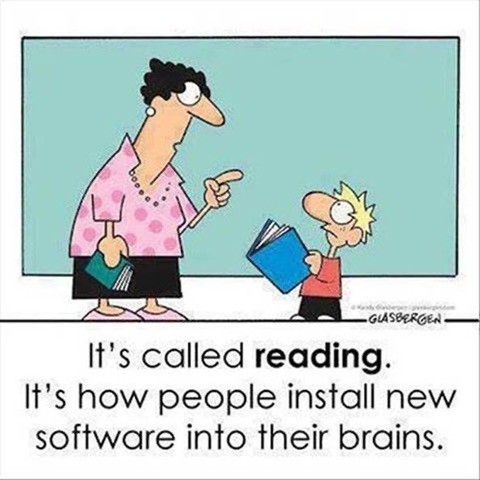
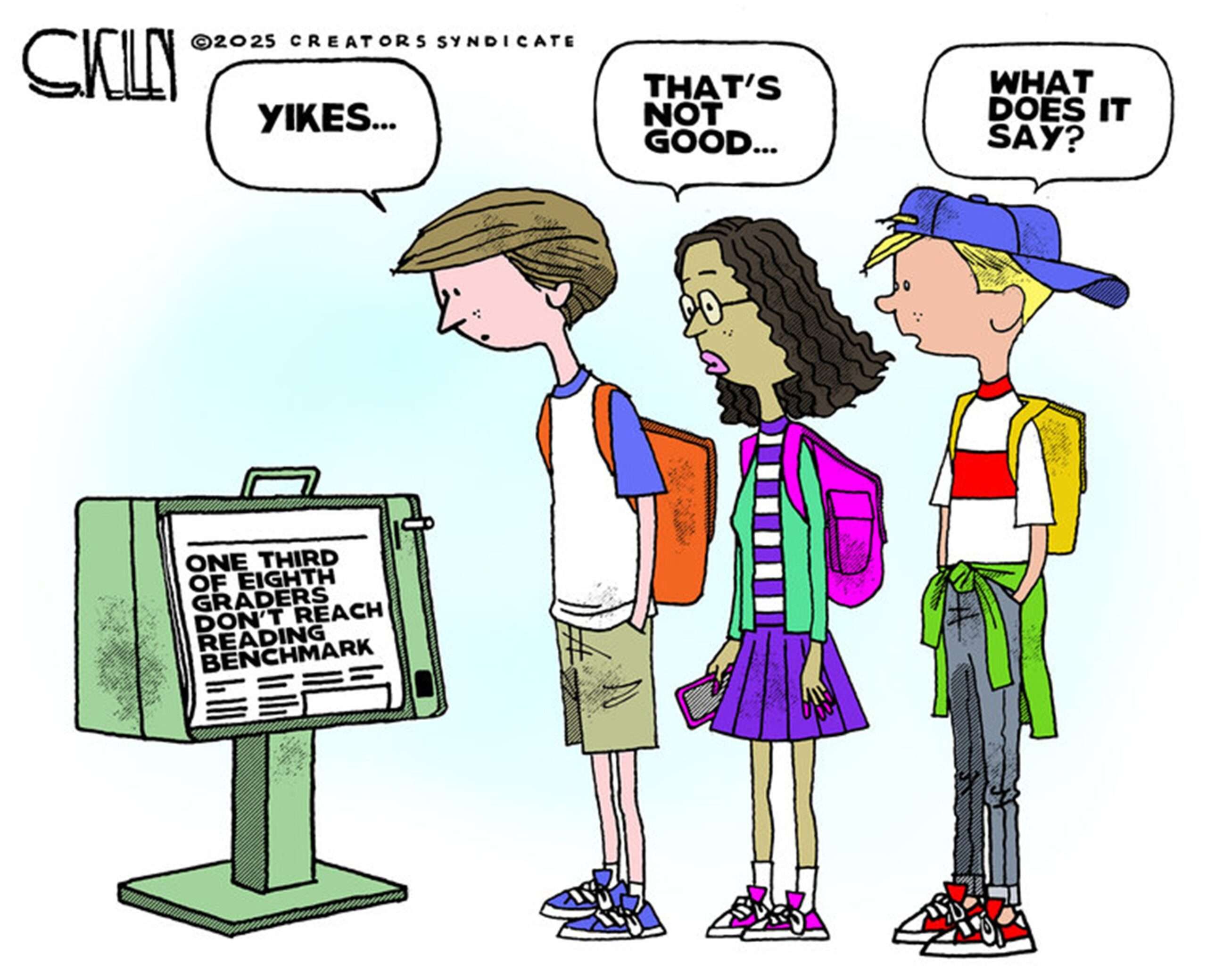
Finally (from a good friend)

singman siu
Posted at 10:11h, 20 JulyThe first thing we should do is to kill the union The agenda of a union is to suck blood out of the institution to death and move on to the next host. don’t buy companies’ stocks are unionized.
printing is invented by Chinese together with paper gun powder and compass, at least that is all the Chinese read in our books. The west automated with the press.
the cartons are funny but there is misprint: it should read made in USA by the Union.
Michael Perez
Posted at 03:00h, 21 JulyI am no fan of unions as they are actualized in the teaching profession, but I disagree with your assessment. IMO, the first thing we do is to raise the standards of training for educators so that those who seek it as a profession are trained in such a way that the current security provided by union membership is no longer needed. Once teachers are trained well and subsequently afforded the respect of professionalism, which is merited by other “professions,” I believe the unionization of the teaching profession will be obviated.