


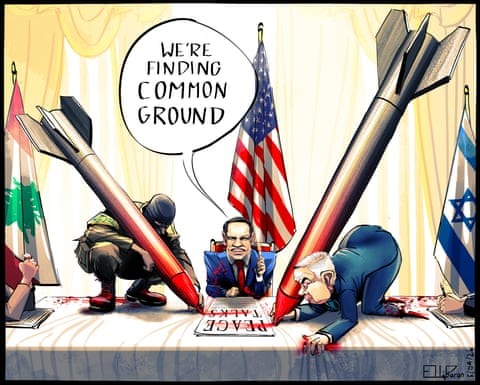
18 Apr Iran War Fallout
“There is and will be further collateral damage from the Iran War.” – The Lonely Realist
We are 7 weeks into the Iran War and markets have been soaring. even more so following comments made by President Trump forecasting an imminent end. Although the Strait of Hormuz was closed in both directions until Friday (the day after Israel and Lebanon agreed to a 10-day ceasefire) – with the Strait being the most important artery in the world for oil (accounting for ~30% of global oil supply), gas (accounting for >25% of global gas supply), fertilizer (accounting for >30% of global fertilizer supply) and helium (accounting for ~30% of global helium supply]) –, the S&P 500 has been steadily rising, closing Friday at a new all-time high that is 3.5% above its level on February 27th. Markets have been shrugging off both the economic effects of the War and its potential repercussions. Nevertheless, without a clear positive resolution, the economic and geopolitical damage from the War will become increasingly consequential. The question is not whether there will be serious fallout. The question is how damaging the fallout will be. For example, how will America and the Theocrats deal with the Islamic Republic’s collapsed economy? How will affected countries — especially China — react if hostilities re-erupt? And if there is a settlement, how will its terms be secured?
Fears that the War would continue through May resulted in March crude oil prices spiking to $120/barrel. They now are hovering at $85-$90. Should the Strait again close, $150/barrel is not hyperbole. The Gulf producers — Saudi Arabia, the UAE, Kuwait, Iraq — are partially compensating by increasing output through alternative export routes, but pipeline capacity is finite with production damaged by Iranian missiles and drones, and tanker diversion adds ~2 weeks of transit time per voyage, effectively removing productive shipping capacity from the global fleet. The result is a supply squeeze amplified by a logistics squeeze. While energy prices have come down from their highs, they remain more than one-third higher than pre-War, while the price predicted for year-end remains $75-$80/barrel. The primary beneficiary is Russia – its crude now is filling Asian demand at premium prices. China has been a purchaser of Iranian oil and has been paying in Yuan, a point not lost on Dollar-reserve watchers — and is reselling refined products into markets desperate for supply. The Iran War therefore is providing a subsidy to America’s enemies.
The now-proven ability of Iran (as well as the Houthis) to restrict supply permanently raises the risk premia for oil and gas (increasing insurance and other inputs as well). That enhances the attraction of renewables, a boon for China…, which accounts for ~80% of solar-technology manufacturing, ~70% of wind turbine production, ~80% of global battery manufacturing, and more than 70% of global electric vehicle production. Sustained high oil and gas prices would be a powerful accelerant for renewable energy investment by those reliant on oil and gas — that is, almost every other country. Those seeking to hedge their oil and gas risk therefore are likely to increase their demand for Chinese solar, wind, and battery storage. China itself gets ~40% of its electricity from such sources and, in the month preceding the War, exported almost $20 billion of solar panels, EVs, wind turbines and batteries. Ken Griffin has stated the obvious: “The world is going to see a massive shift toward alternative fuel sources, including wind, solar and nuclear.”
Although closure of the Strait of Hormuz had an immediate impact on oil and gas prices and, at the same time, drove fertilizer prices to astronomical levels, its effect on food prices is deferred. Given the link between fertilizer costs and food inflation, however, the effects are likely to be significant…, and to persist long after the War has ended. The longer the War lasts, the greater the impact. Affordable food and energy imports are essential for emerging market countries, including Egypt, Pakistan, Bangladesh, and much of sub-Saharan Africa. The higher the cost of energy and food, the more likely that one or more will experience currency pressures and social instability. The fuse for both has been lit.
Much of Europe and Asia already are in an energy crisis. Germany was in recession before the War began and today is absorbing energy costs that threaten its industrial base — chemicals, steel, and automotive manufacturing. Japan, South Korea, and the Philippines are heavy net energy importers and are facing similar pressures. Their manufacturing sectors — automotive and semiconductor for Korea, broad industrial for Japan — face margin compression that will reverberate through global supply chains. The Euro, Yen and Won have weakened sharply, compounding import inflation. The European Central Bank is caught between an inflation mandate demanding rate hikes and a growth mandate demanding accommodation. It cannot satisfy both. Central bank intervention in Korea, Japan and elsewhere is burning through reserves with limited lasting effect.
Which brings us to the U.S., where the immediate military expense of the Iran War is ~$1 billion/day, with the final tally projected to cost American taxpayers $1 trillion. This at the same time as the U.S. is spending over $1 trillion/year on interest to fund a national debt that is increasing at a rate of $1 trillion every 70 days…, which weakens the Dollar. Iran’s decision to accept Yuan for oil sales and transit fees is a small but significant acceleration of de-Dollarization, with China methodically building the institutional architecture for a parallel currency-and-trade order. “Net-net, the Dollar appears to be emerging worse-off from the conflict” according to JPMorgan Chase & Co.
This at the same time as global inflationary pressures are increasing due to higher energy costs and the knock-on effects of the War. The Economist projects that pre-War prices may never return. [ED NOTE: Check out local gas prices which are based on domestic, not Middle East, oil production. The national average price increase is 40%.]
The Iran War was launched without allied support beyond Israel (as TLR previously noted). Spain, Italy, France, Egypt, Qatar, Turkey and others quickly distanced themselves from America’s war efforts. Although plans for a “European NATO” were first vetted last year over U.S. threats to Greenland and Denmark’s sovereignty, they have gained urgency based on America’s unilateral War decisions and President Trump’s explicit threats to withdraw America from NATO. The Trump Administration’s “America First” priorities (and their impact on regional security [the subject of a forthcoming TLR]) are forcing both enemies and allies to reconsider alternatives and, in some circumstances, to band together for common interests. Perhaps that will work out best for all or, as Suzanne Maloney of the Brookings Institution has suggested, perhaps not so well for America: “The Iranian regime is emboldened, the global economy is damaged, our munitions and interceptors are depleted and our allies are further alienated.”
Outcomes nevertheless remain unclear. TLR continues to await developments.
Finally (from a good friend)
THE ASTRONAUTS MUST HAVE BEEN SURPRISED (PHOTO FROM PLANET OF THE APES MEDIA):


No Comments