


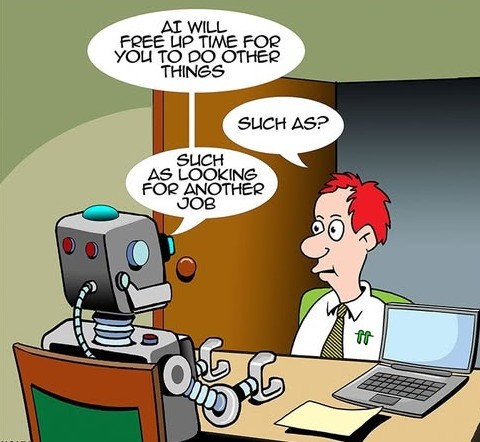
23 May The Stock Market-AI Romance
“Buy the dips?” – The Lonely Realist
Did you sell the rally at the stock market’s recent high on May 14? Are you going to follow the adage of “selling in May and going away”? Or are you instead a long-term stock market investor who sees AI as a revolutionary technology that will continue rocketing the market higher?
TLR has long been a believer in market cycles – that is, an economy goes through a recurring sequence of economic growth and decline that reflects the economy’s evolution over time: expansion, peak, contraction, and a bottom followed by recovery…, rinsed and repeated. Stock market peaks and valleys historically have preceded turns in the economic cycle – that is, the beginnings of both expanding and contracting GDPs. However, today there is widespread belief that the economic cycle is of historical significance only, having been bested by evolutionary improvements in government fiscal policymaking, central bank financial management and ongoing revolutions in agriculture, industrial production, biotechnology and, especially, artificial intelligence (AI). If so, buying the dip at every opportunity will continue to prove itself the optimal stock market strategy.
The fact is that the stock market has been on quite a tear recently, attaining 9 new record closing highs so far in 2026. Those new heights have been achieved on the back of AI-related companies’ appreciation – their aggregate market value now approximates 57% of the S&P500. The AI momentum has driven market indices higher and done so despite steadily increasing geopolitical and inflationary pressures. Mike Wilson of Morgan Stanley is among today’s bullish boosters of stock prices. His forecast is that the S&P500 index will rise to 8,300 by mid-2027 (it is 7,475 today) based largely on increasing earnings per share (EPS) which, insofar as AI-related companies are concerned, has been exceeding expectations and which Mr. Wilson forecasts will rise by double digits over the next number of months. He also believes that the initial impact of the Trump Tariffs caused a mild recession in 2025, a downturn from which the U.S. economy continues to recover and one that will carry the markets higher for the next ~18 months. If correct, stock market prices will not need President Trump’s vaunted interest rate cuts to reach higher levels (meaning that the new Federal Reserve Chairman, Kevin Warsh, may find it challenging to make such cuts). Per Mr. Wilson: “History is supportive in this sense as our backtest shows that multiple expansion is fairly uncommon in periods where the Fed is on hold and earnings growth is strong, but price returns are quite robust in this outcome, driven by resilient EPS growth — the historical median performance in these prior periods is 14%.”
Those who have decided to “sell in May and go away” base their market retreat on warning signs that include stock market prices that exceed levels last seen in 2000 (before the bursting of the dot-com bubble); 30-year US Treasury Bonds, at 5.19%, have reached levels last seen in June 2007 (before the Great Recession); credit card debt has surged to $1.25 trillion with delinquencies at their highest level in >15 years; the global oil and fertilizer shock is fueling inflation with knock-on effects that (together with the Ukraine War) increase geopolitical risk; subprime debt worries have the potential to tip the economy over; U.S. debt soon will surpass $40 trillion; and the pending super-IPOs of SpaceX, Anthropic and OpenAI are priced at nosebleed levels (with each also being offered on “unique” terms). Does the AI revolution represent an unprecedented force for historic economic growth? Or are the doomsayers’ acting as canaries in the stock market coal mine?
Perhaps it is only oracles like Cassandra who can provide an answer (noting that nothing in TLR should be treated as investment advice). However, the feared inflationary effects of the Iran War and their impact on interest rates may well be overstated because of the formulaic calculation of the components of CPI. That is, shelter makes up almost half of core CPI and is computed using weakening dated data. Employment similarly is being counted by reference to historical baselines during a period when the impact of AI on jobs is having profound effects. As TLR previously discussed, “owners’ equivalent rent,” the shelter component of CPI, lags reality by 12–18 months. Data today show that lease rents are falling, vacancy rates are near their cycle highs, and national home prices are on pause. That is deflationary and means that the impact on the CPI’s shelter component is very slowly working its way into CPI data. Labor costs similarly are in decline as productivity increases: although the Bureau of Labor Statistics initially reported that 1.7 million jobs were created in 2025, after revisions and quarterly census adjustments that number fell to 123,000, with the jobs numbers having been adjusted downward over 90% of the time over the last 18 months. That means that 92% of economic growth in the U.S. economy over the last 2 years has come from productivity gains and not from labor growth. This is an accelerating trend that is being driven by technological innovation. It, too, is deflationary (what The Economist has referred to as the “Jobs Apocalypse”). The combination of declining shelter costs and increasing unemployment will lead to revised CPI numbers that, in turn, should lead to lower interest rates. Newly-appointed Fed Chair Kevin Warsh has been charged by President Trump with lowering those rates…, and the odds are that he will.
History teaches that when a nation’s debts become excessive – as they inevitably do if annual deficits and interest obligations continually increase –, inflationary pressures eventually overwhelm prices. The impact of today’s debt and deficits, however, is being offset by the salutary effects of the AI revolution. Although the interest expense on Federal debt has been rising – it hit $1.27 trillion over the last 12 months –, if those rates have peaked, projections of debt and deficits are being overstated. That does not mean that America’s debt and deficits have ceased to be a problem, only that their consequences are being deferred. If the Iran War continues, energy prices will move higher, and since those prices account for ~12–15% of CPI, increasing energy costs alone could add 1-2% to CPI. Although certain inflationary forces – shelter and wage growth – may well be kept under control, geopolitical risks are likely to persist.
However positive the impact of AI, it would be hazardous to assume that the economic cycle has been repealed or that it is impossible for the stock market to suffer a significant setback. While today’s CPI pressures may be overstated, risks nevertheless lurk. It is unclear what might trigger a stock market reset, whether a further energy shock, a blow-up in Iran, Ukraine or Taiwan, bond prices, subprime debt, SpaceX or an unforeseeable “black swan” event. Each is a potential canary in the financial coal mine that today appears to find a successful offset in the AI revolution…, but may not.
Finally (from a good friend)

No Comments