


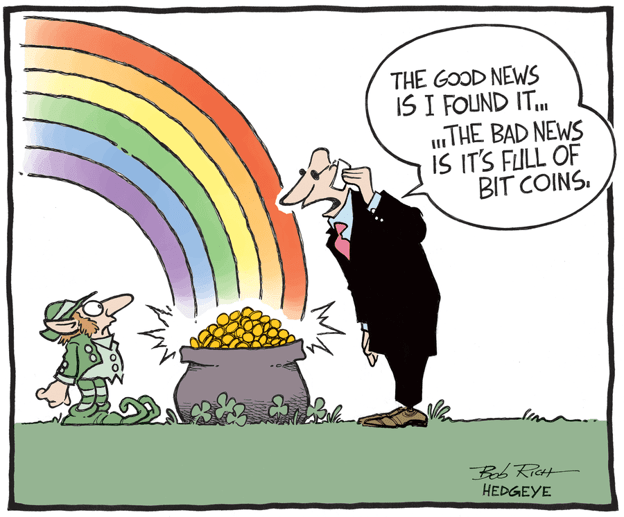
06 Jun The End of Bitcoin?
“Because Strategy, Inc. is a significant investor in Bitcoin, Bitcoin’s price is being adversely affected by Strategy, Inc.’s price.” – The Lonely Realist
TLR wrote in December 2021 about “Bitcon,” using a label intended to highlight what at the time was widespread Bitcoin skepticism. Were Bitcoin’s early owners promoting – and, quite possibly, also manipulating – it in order to turn their Bitcoins into maximum Dollars (noting that Bitcoin’s price at the time was $50,000)? There had been significant selling, which some Bitcoin-haters had characterized as a Ponzi exit. Those who held the bulk of outstanding Bitcoins bought into the Bitcoin Bubble early. TLR pointed out that “Buying Bubbles Early is a profitable strategy … as long as it’s coupled with selling them early as well.”
Which raises the question of who now are the principal owners of Bitcoin…, and who is continuing to support its price?
The largest owners of Bitcoin today (other than governments that have amassed confiscated Bitcoin) are “Satoshi Nakamoto,” Bitcoin’s mythological creator (with an estimated 1.1m Bitcoin) [ED NOTE: that is true only if, unlike other holders of ~3-4 million Bitcoin who have misplaced their keys, he hasn’t done so as well] and Strategy, Inc. (with ~840,000 Bitcoin) (noting that the Winklevoss Brothers own ~70,000, Tim Draper owns an estimated 29,500, Marathon Digital owns >25,000, and Tesla owns ~10,000). Strategy’s 840,000 Bitcoins today are worth ~$52 billion at a time when Strategy has a market capitalization of ~$43 billion (the difference being Strategy’s debt load).
Strategy is a “digital asset treasury company” that began making leveraged bets on Bitcoin in 2020 (at a time when its name was Microstrategy, Inc., a company that Michael Saylor, its CEO, had founded in 1989) and changed its business focus from enterprise software and business intelligence to owning (and becoming the largest buyer of) Bitcoin. The immediate effect was that its stock began trading at a premium-to-value. That success led it to issue as much stock as the market would bear (which it issued at a premium to its asset value) to buy Bitcoin at a (seemingly) ever-rising market price. This led to increased purchases of its stock because its underlying asset – Bitcoin – exceeded its stock price. That continued until November, 2025, when its stock price reached equilibrium with the Bitcoin price. By that time, Strategy already had been utilizing leverage (convertible debt) to purchase more Bitcoin, its premise being that its Bitcoin assets would appreciate at a faster rate than its interest and overhead obligations. Although that trend has reversed over the past 6+ months, Strategy’s Bitcoin buying spree has continued. Strategy has abandoned the further issuance of convertible debt (and repurchased a portion of that debt), and has been issuing a unique financially-engineered “stock” that functions similarly to short-term debt having a one-month floating interest rate (currently 11.5%) and a $100 par value per share, a variable-rate, perpetual preferred stock named Stretch. In doing so, Strategy has made it clear that it is “all in” on Bitcoin. Should Bitcoin tank, so will Strategy. A question, however, is what would happen to Bitcoin if Strategy were to “tank”?
Strategy has addressed this two-sided problem by creating a cash reserve to ensure that its overhead plus its interest and dividend obligations do not push it into insolvency (the amount of that reserve currently is ~$2.2B). Its intent is to maintain its reserve at a level sufficient to fund 12-24 months of operations. Although this financial buffer would prevent economic pressure from forcing a sale of its existing Bitcoin, it would not provide funding for Strategy to continue purchasing additional Bitcoins…, and there lies the rub.
For readers who have not been following the Bitcoin saga, Bitcoin’s price peaked in October 2025 at $125,000. Its current price is ~$62,000 with the average price paid by Strategy for its Bitcoins being ~$76,000. Significantly, demand for Bitcoin as a corporate treasury asset has almost disappeared outside of Strategy. For example, in October 2025, 95% of corporate Bitcoin purchases came from other long-term holders, a share now reportedly just 2%. Strategy’s buying nevertheless has continued to be robust, even though its stock is trading >70% below its 52‑week high and Bitcoin’s price has fallen 50% from its October peak. Strategy purchased ~45,000 Bitcoin in March (when other long-term Bitcoin holders bought 1,000 Bitcoin), another 15,355 in April, and 25,404 in May, its buying accounting for ~12% of all trading activity in Bitcoin.
The Bitcoin price therefore is being largely supported by Strategy. Should Strategy’s Stretch sales fall short (or should they fail), that buying pressure will ease. Since Strategy is a public company, that easing will be transparent and cause Bitcoin’s price to drop. Should the price of Bitcoin drop, Strategy’s ability to market its preferred stock will drop, which will prevent it from purchasing additional Bitcoin and lead to a further drop in Bitcoin’s price, etc., etc., etc. (unless another buyer of size should step in). Strategy’s May sale of a mere 32 Bitcoin for ~$2.5 million (at an average price of $77,135) (reported in a late-May SEC filing) shook the markets, with some cautioning that it may prove to be the proverbial canary in a crypto mine. Although the (quite modest) proceeds were simply used to fund distributions on its highest-yielding preferred stock and despite the fact that Strategy continues to hold ~844,000 Bitcoin, the price of Bitcoin has dropped – by >$15,000! – and the current trend has a distinctive down arrow. Even so, enthusiasm for Bitcoin remains, and not just from retail punters, drug dealers and extortionists, but also among institutions (such as Tether) and ETFs. Moreover, the supply-demand ratio is supportive since the supply of Bitcoin is destined to dwindle because of its cap of 21 million and the requirement that Bitcoin issuance be reduced by 50% every 4 years. The reality is that over its more than 15-year life, Bitcoin has become an integral part of global finance with core owners unlikely to jump ship, certainly not in a size sufficient to threaten its existence. Bitcoin therefore will not soon “end.” Investors nevertheless should expect volatile times ahead (noting, once again, that nothing in TLR is ever investment advice).
The Lonely Realist now can be found on Substack at https://substack.com/@thelonelyrealist?utm_source=global-search.
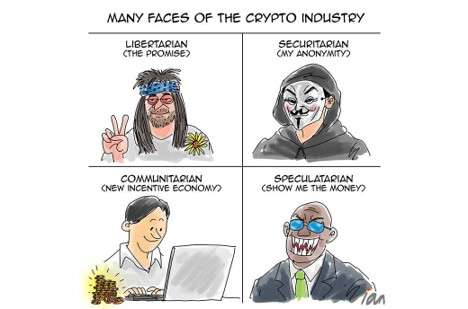
Finally (from a good friend)


No Comments