


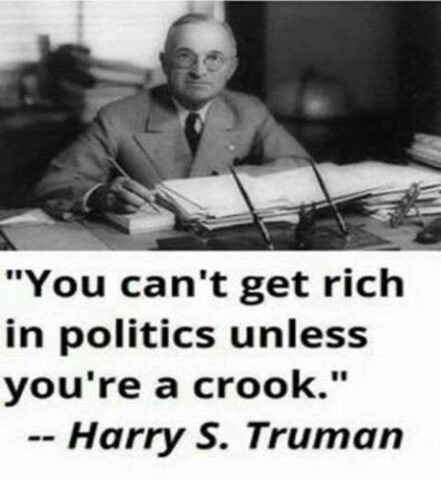
08 Aug Insider Trading by Elected Officials
“Trading on inside information is illegal. America’s elected representatives nevertheless profit from doing so.” – The Lonely Realist
Congress once again is engaging in an election year public relations show. The House of Representatives recently passed the Stop Insider Trading Act which (in part) seeks to prevent discourage members of Congress, their spouses and children (but not their other family members) from buying publicly traded securities (though not privately offered ones or ETFs). Congress has been here many times before, so don’t expect the Stop Insider Trading Act to become law and stop Congressional (or Executive) insider trading.
Readers of TLR undoubtedly are (once again) shocked to be reminded that, even though insider trading has been illegal since the 1940s, members of Congress have had free rein, and have readily used that reign rein, to unreservedly trade on inside information. It wasn’t until 2012 when 25 members of Congress were caught profiting from their trading on material, nonpublic information about military expenditures (as well as on other information that the American public wasn’t privy to) that Congress enacted the Stop Trading on Congressional Knowledge Act (STOCK Act), which directed members of Congress and their spouses to disclose within 45 days any trades over $1,000. Because the only penalty is a $200 fine, members of both Parties have failed to file reports on time or, often, at all. It therefore is unsurprising that significant insider trading has continued. For example, the media highlighted the trading that occurred in advance of the COVID epidemic in 2020 when members of Congress traded on their foreknowledge. It also is unsurprising that every few years a few members of Congress use their soapbox to propose legislation to … eliminate address elected officials’ abuse of insider information.
Although prior to the STOCK Act, members of Congress faced no limitations on insider trading, the 2012 STOCK Act sought to eliminate abusive Congressional insider trading through transparency. That didn’t work, its few teeth resulting in widespread abuse and zero enforcement. The WSJ’s 2023 “Capital Assets series” reported that, among the many recorded abuses of the STOCK Act from 2019-2021, 97 members of Congress, their spouses or dependents traded stocks in companies overseen by committees on which they served, and many Executive Branch employees bought and sold stocks in companies that their agencies regulated. The Ban Stock Trading for Government Officials Act of 2023 would have added financial penalties to the STOCK Act, eliminated the use of “blind trusts” to avoid the appearance of distance (because blind trusts provide the appearance, but not the reality, of ownership-and-control separation), and banned the trading of individual stocks by members of Congress and senior Executive Branch officials, their spouses and dependents (although it would not have added criminal penalties or expanded the list of “related parties” to include other family members – both of which were significant omissions). In 2022, the fig leaf was Banning Insider Trading in Congress Act, which would have pressured Congressmembers to place their assets in blind trusts. The 2024 proposal was dubbed the Ending Trading and Holdings in Congressional Stock Act (ETHICS Act) which, among other things, would have prohibited members of Congress, their spouses and dependent minors from owning or trading financial instruments in the belief that anything short of outright prohibition would be ineffective. In 2025, Senator Hawley (R-MO) proposed the Halting Ownership and Non-Ethical Stock Transactions Act (HONEST Act) that would ban the President, Vice President, and members of Congress (plus their spouses and dependents) from owning, buying, or selling financial investments. Unsurprisingly, none of these proposals has made it through Committee to the floor of either the Senate or the House. That was true until the Stop Insider Trading Act…, which recently passed the House by a vote of 232–198, passing only because it includes the Voter ID Act that incorporates provisions from the SAVE America Act requiring photo identification for Federal voting. Even so, the consensus is that it is doomed in the Senate.
Members of Congress (as well as of the Executive Branch) quite simply are unwilling to give up their insider trading perks [ED NOTE: As TLR has observed, there are any number of reasons why elective office is an American child’s best career choice]. As Senator Jeff Merkley noted, “The fact that members of Congress do better than a generalized portfolio suggests that there’s privileged information that folks hear about — may not be inside information, maybe it’s early information, maybe it’s an insight that comes from working on a sector through your committee work or so on and so forth, but that is an issue.” It most certainly is! Members of Congress have done so well buying and selling securities that a website dedicated to their activities was created to allow investors to track trades reported by Congressmembers. There also is an app called Autopilot that allows subscribers to select various members of Congress and automatically trade the same stocks as the selected member or his/her spouse. That too can be quite profitable. The fact is that information about the trades executed by members of Congress and their spouses provides a significant market edge. It provides ample evidence that the STOCK Act is ineffective as a check on Congressional insider trading. The HONEST Act would have had a totally different, salutary, impact, but it never had a chance of passing Congress.
As has become an accepted reality (and as TLR has been highlighting for over 7 years), Congress is broken. It has absolved itself from responsibility not only for the actions of its own members, but also for the actions of the Executive Branch. The Constitution provides for a Balancing of Powers that requires members of Congress to exercise their legislative responsibilities. Congress instead has been feathering its own nest. Democracy requires a mature, accountable legislature. The hope is that someday, perhaps as soon as this coming November, it will get one.
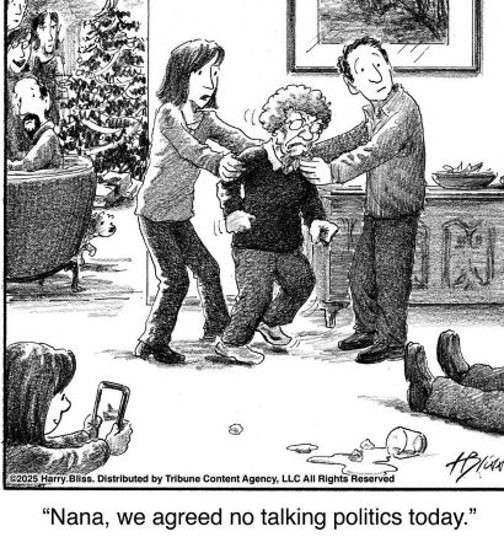
Finally (from a good friend)

No Comments