


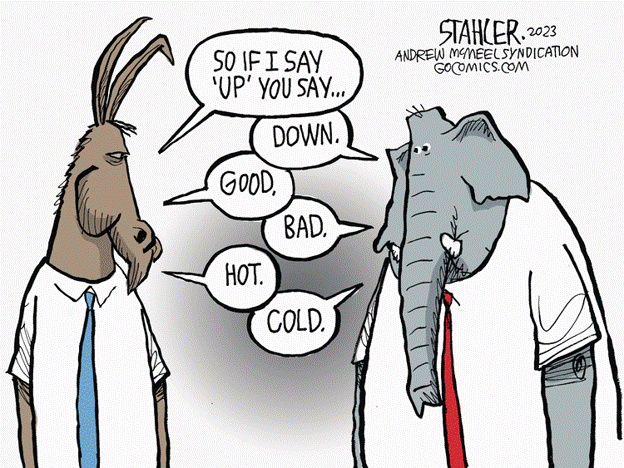
10 Oct In Praise of American Democracy
“There are three different definitions of ‘democracy’: one for those on the far right; a second for those on the far left; and a third for everyone else.” – The Lonely Realist
“American democracy” means different things to different groups of American tribalists. Each wants to save its brand of democracy from the depredations of the others, painting those others as unAmerican or, at an extreme, treasonous, demonic and Godless. For those on the far left and far right, saving “American democracy” has meant branding those with different views as agents of evil. Hardly E Pluribus Unum! Dialogue for many therefore is an exercise in name-calling with designated social media as the sole fount of “truth.” Divisive rhetoric necessarily provides little room for discussion or hashing out of common interests. Yet America is called the United States for a reason. There is not merely a single basis for discussion, there are multiple bases for actual agreement. With each tribe talking past the others, however, trolling for those who speak the same language, today’s America has become a social-media Tower of Babel. Saving “American democracy” accordingly has become a battle cry, not to rally around for the national self-interest, but to oppose those who support a different interpretation of “American democracy.”
The Constitution mandates a representative government in which each American adult has one vote that can be exercised regardless of race, sex, religion, education, wealth or other factor. It exalts a form of democracy based on equality of representation, “one-person, one vote.” However, that doesn’t mean that every person’s vote counts equally, only that every vote is counted. With gerrymandering integral to American political life (addressed by TLR here and here), with the Electoral College providing for disproportional State-by-State vote-counting (addressed by TLR here), and with the Supreme Court having implicitly sanctioned the use of voter ID laws, limitations on voting times, restrictions on voter registration, and the purging of voter rolls, America’s form of representative democracy is not intended as a form of direct democracy. Indeed, “History has shown that both major parties are perfectly willing to rig the electoral rules to benefit their own, and to draw the lines to punish opposing partisans.”
American democracy accordingly is a free-for-all that, in the 21st Century, has exacerbated political differences and thereby entrenched tribal loyalty. America’s history shows that such free-for-alls work themselves out over time. The danger today is that a unique combination of American political idiosyncrasies has fertilized destabilizing extremism, both from the left and the right.
Over the last >30 years, Republicans and Democrats have divided their constituents over any number of single issues, including gun rights, abortion rights, the Electoral College (addressed by TLR here), the philosophical composition of the Supreme Court (discussed by TLR here), the extent to which States Rights should exceed Federalism (discussed by TLR here and here), limiting or expanding immigration (addressed by TLR here and here), validating or eliminating gerrymandering (addressed by TLR here and here), affordability (discussed by TLR here), and determining whether the filibuster makes America a greater or lesser democracy. Democrats believe that government necessarily must provide a relatively high level of services and protections to the public and Republicans believe that government should provide only essential services and protections. For the great majority, precisely how much would be appropriate is a matter of degree and, in the past, a matter for discussion and compromise.
That’s no longer true today. Those on the far left and far right have ceased to believe in compromise. Each takes a radically different approach to American democracy, with each seeking the support of voters who, weary of politics and politicians, are drawn to anti-establishment populism.
Those on the far left advocate cradle-to-grave government support to lure the economically disadvantaged. They would eliminate “capitalist excesses” through increased taxation of the wealthy (reflected in proposals for Medicare for All, tuition-free public college, writing off student debt, Federal job guarantees, a Green New Deal, and abolishing U.S. Immigration and Customs Enforcement). The far left believes that the people to whom power should devolve are those who currently have little economic influence. For them, government should be the provider, bigger government is more benign government, and power should rest in a paternalistic government that doles out equity and equality.
Those on the far right agree that America needs an all-powerful Federal government. Seeking the support of the socially disaffected, right-wing extremists advocate a radical departure from what they label an entrenched liberal bureaucracy and the severing of ties with established business and political leaders. Vice President J.D. Vance has said that America is “going to have to get pretty wild, and pretty far out there, and go in directions that a lot of conservatives right now are uncomfortable with.” His politics focuses on the belief that America has been controlled by Ivy Leaguers who have led America down a path to dystopian collapse, equating culture warfare with class war: “[W]e should seize the institutions of the left … by fir[ing] every single midlevel bureaucrat, every civil servant in the administration state, replace them with our people. And when the courts stop you, stand before the country and say ‘The chief justice has made his ruling. Now let him enforce it.’”
Ronald Reagan was the poster-President for small government, believing that big government – whether from the left or the right – compounds problems. The majority of voters, both traditional Republicans and traditional Democrats, believe in efficient, effective government. The conflict today is not between those traditionalists, but between those in the middle and those at the extremes.
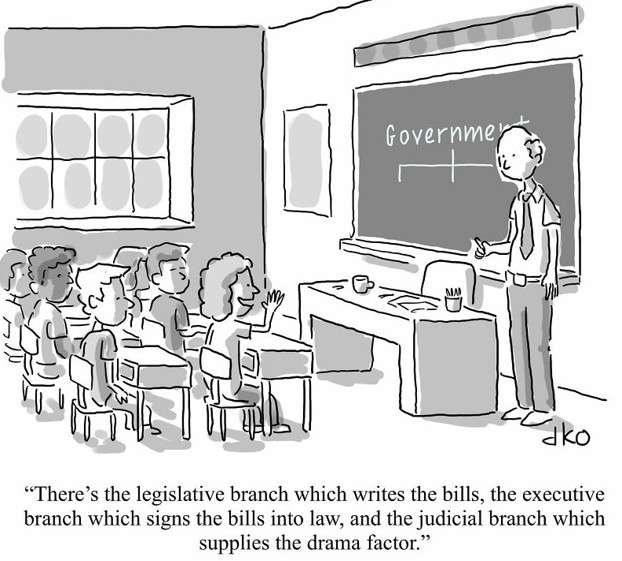
American-style democracy relies on a balance of power among the three branches of government, requiring decision-making to be deliberative so that issues can be debated and solutions reached that benefit the nation as a whole. In the absence of broad consensus, American-style democracy is not activist. It does not easily or quickly change direction. Today’s extremists have a different agenda, exaggerating problems that, accordingly, require immediate, radical change. American democracy has a 240-year history of success in alternating liberal and conservative governments that have thwarted the pretentions of every category of demagogue. America’s democracy has thrived because of its adherence to the Rule of Law (discussed by TLR here), its unparalleled (though admittedly imperfect) racial justice, and multiple cycles of demographic change. It has rejected race, sex, religion, education, wealth and other differentiating prejudices, successfully addressed economic hardship, poverty and inequality, united against adversity and adversaries, and successfully promoted the American Dream (discussed by TLR here), American Exceptionalism (discussed by TLR here), American capitalism (discussed by TLR here), and the American education system (discussed by TLR here). That’s American democracy.
Finally (from a good friend)
No Comments