


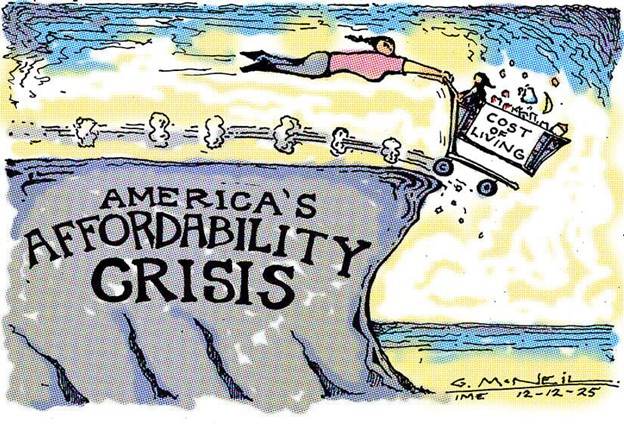
09 May The Affordability Crisis
“Should America wage a ‘War on Unaffordability’ as the 21st Century successor to the 20th Century’s ‘War on Poverty’?” – The Lonely Realist
Is there really an “affordability crisis”? If so, when might such a “crisis” become “critical”?
It was a little more than 60 years ago that President Lyndon Johnson declared a “War on Poverty.” In his 1964 State of the Union address, he characterized eradicating poverty through Federal programs as America’s highest domestic priority. The Economic Opportunity Act of 1964 that followed from his address established the Federal agency that funded programs like Head Start, the Job Corps, and Volunteers in Service to America. They were followed by the Food Stamp Act of 1964 and the Social Security Act of 1965, which established Medicare and Medicaid. Poverty in America plunged by 50% over the next several decades as the War on Poverty was expanded through a series of entitlement programs that covered disadvantaged children, the elderly, the disabled, veterans and those living below the poverty line with programs that include food stamps, housing subsidies, household welfare payments, and farm and corporate subsidies. Each program in itself was well-targeted. Each, however, generated its own bureaucracy and, because each program was designed to address a specific constituency problem, there have been unintended overlaps, increasing opportunities for fraud, and a limited government ability to monitor duplicative services and payments. Nevertheless, progress in reducing poverty has been impressive.
“Living in poverty,” however, differs materially from “lacking affordability.”
Living in poverty means having an inability to access essential resources that together constitute a minimum standard of living, namely food, clothing, shelter and basic services. It represents a non-discretionary inability to independently provide for one’s basic needs. According to census data, the U.S. poverty rate was 11.1% in 2023 (representing a vast improvement in the human condition as innovation, expanding production and government largesse has lifted ~70% of the population out of poverty over less than two centuries).
Lacking affordability, on the other hand, means having an inability to self-support an existing lifestyle that relies on the ability to purchase reasonably priced goods, services, housing and other “middle class essentials” (including, perhaps(?), childcare, education, healthcare, and retirement savings). Affordability requires a balancing of income against the costs of goods and services that would allow an individual to maintain (and have the opportunity to improve) his/her standard of living. Rising costs chip away at a cornerstone of the American Dream, namely a middle-class lifestyle, creating the perception of neediness as well as the potential of falling into poverty. Per Gallup, that is of increasing concern, with 55% of Americans dissatisfied with their current economic position and concerned that they will be unable to continue supporting their standard of living. This is the largest percentage of dissatisfied Americans in the last 25 years…, even though Americans live a secure, economically bountiful and partially government-supported lifestyle. Statistics nevertheless confirm that “unaffordability” is the term Americans are using to describe their dissatisfaction with that reality. A recent Talker Research survey of 2,000 Americans found that 32% are currently experiencing an existential crisis, with financial pressure being the dominant factor, and a separate survey of 5,000 Americans reported that 87% of Americans believe the country is in an “affordability crisis” with half struggling to pay basic bills and with Gen Z leading all generations in its level of dissatisfaction.
How America ought to address a “crisis” that is adversely impacting America’s laborers, America’s youth and the poorest Americans in what has been termed “America’s K-shaped economy” is a complex question. It is those wage earners, members of Gen Z and poorest who indeed are priced out of housing, being humbled by inflation and seeing a decline in their standard of living, with their job prospects held back by a variety of factors, including unretiring Baby Boomers and the AI revolution. The temporary boost from tax refunds is fading post-April 15th, the cost-of-living from necessities like energy and food is rising (and likely to continue doing so), and the savings rate already is uncomfortably low at 3.9%, all of which leaves those in the bottom half of “the K” with declining prospects – truly a developing crisis. Any proposed solution would be politically hazardous and require addressing the very real economic burdens being borne by those in the bottom half(?) of the economy. Each, as a separate group, needs to be pushed above the “reasonable standard of living line,” whatever that should be (some commentators arguing that the poverty line – not the affordability line – for a family of four today is >$100,000).
One way of addressing the crisis (and TLR asks readers to suggest others) is through a Universal Basic Income (UBI), a form of economic relief first vetted by President Nixon in 1969…, who ultimately decided not to pursue it because of the political blowback … and not because of its lack of economic viability. The principal hurdle is funding. Adopting a national UBI necessarily would require eliminating duplicative entitlement programs (a simplification that TLR has long advocated) along with the concomitant elimination of the bureaucrats and bureaucratic costs of managing those entitlement programs.
Addressing America’s “unaffordability crisis” through a UBI or UBI-like formula would have the beneficial effect of further reducing the number of Americans living below the poverty line as well as providing members of Congress with a rare opportunity to simultaneously detriment benefit multiple voter constituencies. Given escalating disenchantment with the status quo and growing consensus about unaffordability (based, in part, on reductions in Obamacare, proliferating debt and deficits, and foreseeable Social Security reforms), the time to do so is fast-approaching. UBI has not been short of advocates (including tech bros Elon Musk, Sam Altman and Mark Zuckerberg, and economists Milton Friedman and Herbert Simon). Outright political support, however, has been thin and would require leaders in both Political Parties to take up the call for UBI and entitlement simplification, the latter being a traditional Republican Party platform plank. Initial support for a national UBI would have to come from Democrats, perhaps by advocating for an updated “Freedom Dividend” similar to the one proposed by Andrew Yang in his 2020 Presidential bid. The ingredients for compromise exist. They could become ripe for coalescence when a new Congress convenes in 2027.
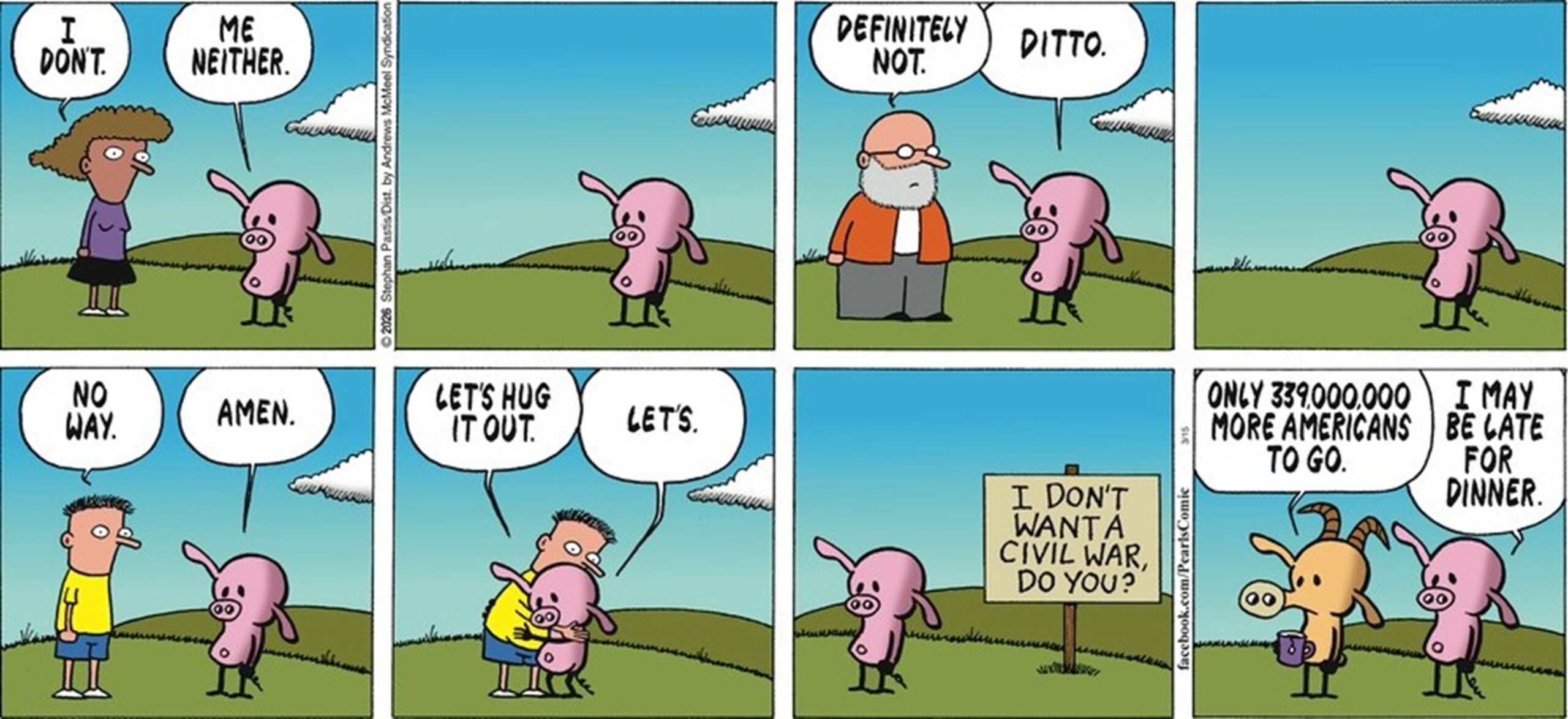
Finally (from a good friend)
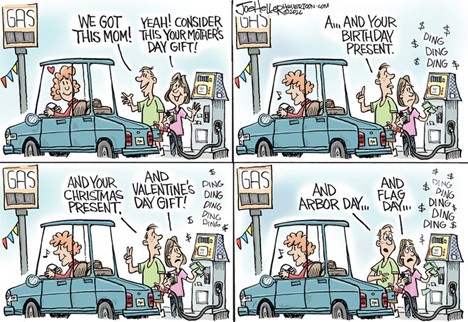
HAPPY MOTHERS DAY!

No Comments