


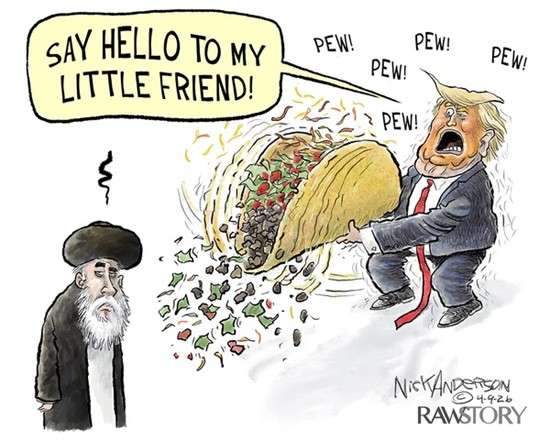
29 May The Expanding Islamic Republic?
“The Iran War has strengthened the Islamic Republic…, or has it?” – The Lonely Realist
President Trump announced on May 23rd that a “PEACE Agreement” with Iran “has been largely negotiated” and that the details would be “announced shortly.” It hasn’t happened (yet?). Although the President and members of his Administration repeated the story over the following week (with Secretary of State Rubio adding that the Agreement might take “a few more days”), no deal has been forthcoming (with Iranian spokesmen labeling the Administration’s announcements an exercise in public relations). Western media reported that the Agreement would provide that both sides would reopen the Strait of Hormuz and end their blockades, the U.S. would release a portion of frozen Iranian assets and lift certain sanctions, and the parties would have further negotiations over the succeeding ~60 days to address nuclear issues and the lifting of further sanctions. Al-Jazeera reported that the Agreement would include “unfreezing billions in Iranian funds, lifting the U.S. blockade, pulling U.S. forces away, reopening Strait of Hormuz though with tolls to Iran, and allowing Iran to keep its enriched uranium.” Either version, if accurate, would empower the Islamic Republic and place it a more dominant position in the Middle East than it occupied before the Iran War.
President Trump has been actively signaling his desire over the last 2 months to extricate the U.S. from the War. Although the President initially demanded an Iranian “unconditional surrender,” he has since restated his goal as a negotiated settlement that can be sold to Wall Street (allowing the stock market to attain further heights) and the American public (with the President adding that Israeli Prime Minister Netanyahu “will do whatever I want him to do”). The Theocrats have read the President’s signals as confirmation that they have the superior negotiating position and that time and escalation management are on their side. If correct, this asymmetry will dictate the terms of the “PEACE Agreement.”
Iran’s negotiating strategy depends on delay and obfuscation. Diplomacy is not the means it utilizes to achieve a resolution…, yet alone a compromise. Its diplomacy instead is a device for applying pressure and evading direct conflict, a means for testing the patience and self-imposed limitations of adversaries. It’s a strategy that has characterized Iran’s actions for millennia, one that the Islamic Republic successfully employed during the 1979 hostage crisis, during the Obama-era (where prolonged negotiations taking over 2 years, patience and inflexibility in the face of persistent American military threats led to an outcome it found acceptable), and over the past 18 months.
President Trump’s transactional approach to foreign policy has validated the Theocrats’ belief that, although America can exert severe pressure (through sanctions and large-scale military operations), the Theocracy can survive. It also has reinforced the conclusion that time is on Iran’s side and that America will not stay the course…, the same conclusion that the rest of the world now has reached. The Islamic Republic accordingly has been using the last 2 months (during America’s self-declared cease-fire) not only to rearm, but to cement its control over the Strait of Hormuz by demanding that those wishing to ensure the future flow of oil through the Strait agree to “transit agreements.” The goal of those agreements is to reward Iran’s partners (e.g., Russia and China), allow “friendly nations” (e.g., India and Pakistan) to negotiate favorable terms, and charge high fees or preclude those without transit agreements from passing through the Strait. Should the proposed “PEACE Agreement” be finalized, no matter its substantiality, countries dependent on energy from the Persian Gulf – including America’s NATO and Southeast Asian allies— will be compelled to cut deals that allow them to obtain the critical commodities they require to repair their damaged economies. Should the proposed “PEACE Agreement” become reality, the international sanctions against Iran also will collapse.
If so, there will be significant collateral consequences. Because America would have proven itself weaker (both militarily and diplomatically) than previously understood, America’s adversaries will pressure Western allies and alliances and test America’s determination in other parts of the world. Russia this past week did so by targeting NATO member Latvia and by the message delivered by Russian Foreign Minister Lavrov to Secretary of State Rubio advising Secretary Rubio that Russia will be escalating its Ukraine campaign by launching systematic and consistent strikes against facilities in Kyiv and relevant “decision-making centers,” recommending the evacuation of American diplomats and citizens from Kyiv, and “expressing regret” at the impasse over a Russia-Ukraine peace deal. America has not responded in kind by pledging additional support for NATO/Ukraine. To the contrary, it announced a further reduction in military support for NATO by scaling back what it had earmarked to defend its allies in a crisis – quite a message! Perhaps President Trump intends to embrace isolationism by doubling down on his spheres of influence message by bringing Cuba to its knees and commencing military operations against Greenland, demonstrating that America will be exercising sovereignty over the Western Hemisphere (and will be leaving China to dominate Asia and Russia to exercise dominion over Eastern Europe). Doing so, however, would only encourage escalating global aggressions by America’s enemies.
Even more significant is the impact the vetted “PEACE Agreement” would have on Israel. Should the Agreement play out as described by the media, Iran will emerge stronger, more influential and with greater leverage than it had before the War. Countries that supported Israel would be less likely to take Israel’s side in any conflict, because the Islamic Republic would have the means to punish them if they did. The vetted “PEACE Agreement” accordingly would revitalize Hamas and Hezbollah and further empower the Houthis, put an end to the Abraham Accords, and compel the Gulf States to make a separate peace with Iran to maintain social and economic order. Iran therefore would replace America as a dominant Middle East power and enable it to use its proxies to carry out a war of attrition against Israel without American consequence. The outcome of the Iran War would find an Israel more isolated than ever before, abandoned by its only reliable protector, with its isolation made all the more extreme by a growing bipartisan anti-Israel consensus in the U.S. that would be likely to grow.
America has a choice: It can embrace the “PEACE Agreement” and live with its consequences; or it can pursue military victory in the War. The latter is the traditional role of a hegemon. The former is what happens when a hegemon elects to cede its hegemony.
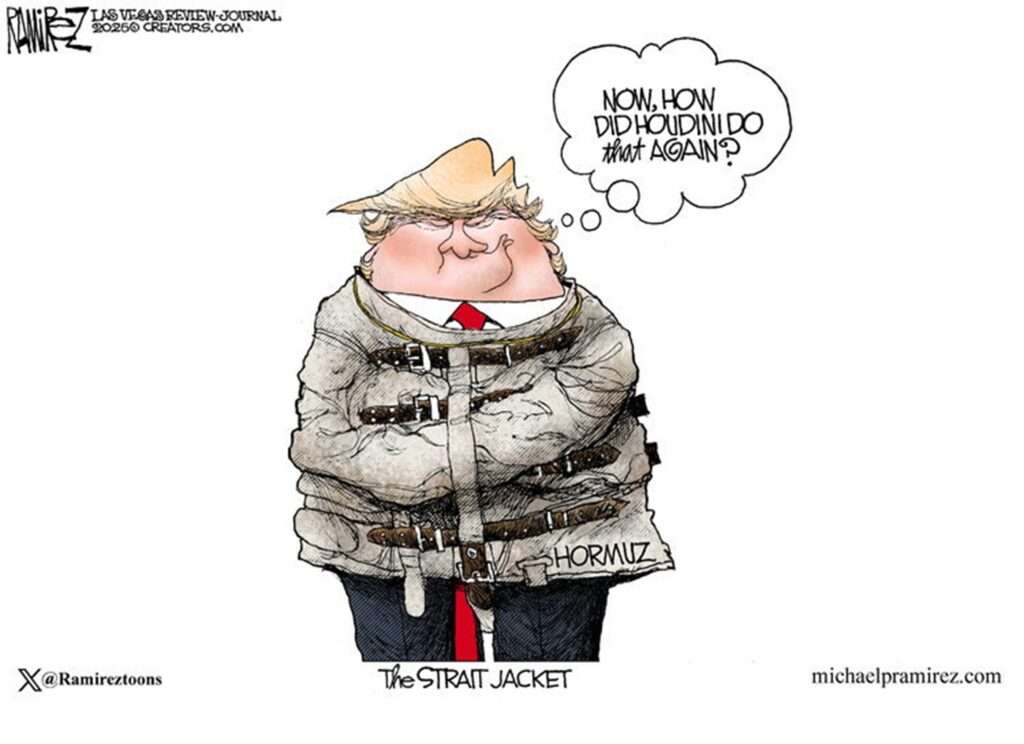
Finally (from a good friend)


No Comments