


15 Aug Capitalism vs. Democratic Socialism
“Which ‘-ism’ is right for America?” – The Lonely Realist
Every country chooses its own “-ism”:
Capitalism: Private owners run trade and industry to make money with little government control.
Socialism: The government owns or controls the significant industries and works to share wealth among people.
Communism: The government owns all property and controls all production and distribution.
Fascism: A single leader holds total power and controls the means of production and distribution.
Nazism: A single leader holds total power, uses military force, and stops free speech and protest.
The risk – too much government: Government intrudes on virtually all aspects of daily life, creating confusion, waste, and inefficiencies.
The risk – too little government: Laws, rules, regulations and enforcement are inadequate, resulting in anarchy.
A more illustrative description of ‘isms’ is:
Capitalism: You have two cows. You sell one and buy a bull. Your herd grows, and you sell milk to make money.
Socialism: You have two cows. You keep one and give the other to your neighbor.
Communism: You have two cows. The government takes both and gives you a share of the milk.
Fascism: You have two cows. The government takes both and sells the milk back to you.
Nazism: You have two cows. The government takes both and shoots you.
The risk – too much government: You have two cows. The government takes both, shoots one, milks the other, and pours the milk down the drain.
The risk – too little government: You have two cows. They disappear and the government shrugs.
Democracy and capitalism go hand-in-hand. Democracy is “a system of government where power is vested in individuals and the government belongs to the people.” “Democratic socialism” therefore is a contradiction in terms.
Although the world (and TLR) has viewed America as the global exemplar of capitalism, its capitalist crown has been slipping. One criticism of American capitalism is its recent attraction to Statism, which is a blending of capitalism and central government planning (in a Chinese Communist sense) where the government intrudes on the private sector by obtaining a voice (sometimes a principal voice) in both macro- and micro-business direction and decision-making. Moreover, since the 1930s, American capitalism has incorporated a significant dose of social welfarism – despite its being a foundational component of socialism – through Social Security, Medicare, Medicaid, unemployment insurance, anti-poverty programs, etc. These are worthwhile safety nets that are consistent with the American goals of safeguarding individual freedoms, providing individuals with economic opportunity and incentives (including to build, create and expand), and ensuring a balanced society where all Americans are treated fairly pursuant to a uniform application of the Rule of Law. The American success story proves their worth. Achieving American success, however, has required making compromises and avoiding extremes. Alternating Republican and Democrat Administrations have worked to balance laissez-faire economic policies, which necessarily create winners and losers, with social safety-net policies intended to offset the more extreme consequences of capitalism. As America’s wealth and GDP have expanded, so has America’s safety net. FDR crafted the New Deal to introduce government-financed social welfare programs, LBJ pursued Great Society initiatives to expand on those programs, and Ronald Reagan pushed back with Reaganomics by executing policies intended to offset some of the perceived disincentives that social welfare programs had engendered. Etc.
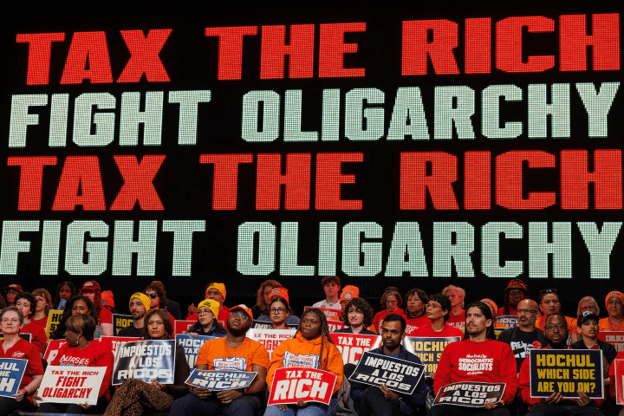
A repudiation of American capitalism today is being advocated by the Democratic Socialists of America (DSA), the far-left faction of the Democratic Party the platform of which includes providing all Americans with Medicare, a college education, childcare services, a transition to 100% renewable energy (and increased taxation of oil, gas and coal companies), a 32-hour workweek, Federal rent control, affordable housing, defunding of the police and ICE, abolishing prisons, rewriting the Constitution to empower an absolutist unicameral form of government, reducing the defense budget, ending sanctions against Iran, Cuba and others, reversing American policy towards Israel, and supporting Palestinian self-determination, freedom, and liberation. The DSA platform provides a heady mixture of handouts and slogans that include promises that “your retirement will be publicly funded and food, education, energy, medicine, and transportation aren’t run by for-profit businesses, but are common goods and utilities for everyone.” While the DSA platform has an allure for some, its flaws are apparent to others. After all, there is no such thing as a free lunch, especially with America’s economy already accumulating $2 trillion annual deficits and a $40 trillion debt. Socialism and democracy after all are incompatible. The DSA’s promises of government funding of everything for everyone is the populist message that revolutionaries use to shield radical political agendas, which is consistent with a DSA platform that looks, smells and tastes like Bolshevism.
Progressive Democrats accordingly are attempting to distinguish their goals from the DSA’s. [ED NOTE: Perhaps they’re missing the point recently made by Bob Lefsetz that “Change is like a volcano, it rumbles until it overflows. Is America ready for the [DSA] volcano to erupt?”] Political commentator Van Jones, in rejecting the “far left” policies of the DSA, focuses on what he calls core “progressive ideals and policies: criminal justice reform, a Green New Deal, Medicare for All, free education, clean air and water.” Heather Cox Richardson describes the policies of both the DSA and Progressive Democrats as “government control of the aspects of society required for people to participate in the economy on a level playing field. While Democratic Socialists embrace a wide range of policies, they generally don’t think schools, or medical care, or roads, should be profit-making industries.”
Richardson’s characterization of Progressivism as seeking “government control” is the very definition of socialism – and that’s true whether we’re talking about the radical, political kind of socialism advocated by the DSA or the “core progressive” kind described by Van Jones. This is the same “socialism” that history shows doesn’t work and, importantly, also one that is antithetical to the basic tenets of Americanism and democracy. America has embraced a capitalist system that endeavors to balance equity, justice, economic success and economic opportunity without placing the government’s finger on the scales. The costs required to do so – that is, to finance the current economic playing field and social welfare programs – has required precisely the historically high level of economic success that the American experiment has enjoyed. The cry from Progressives that “every billionaire is a policy failure” is an explicit repudiation of that success because it links wealthy Americans with a rigged economic system. Yet most American billionaires have derived their wealth by creating or providing useful goods and services. Unlike their European peers who inherited their wealth and Russian peers who became rich through a fixed system, they have worked to realize the American Dream and, in doing so, provided employment for millions of Americans (estimated to total >25% of today’s workforce). That undoubtedly is because American capitalism has flourished under a fair and balanced judicial system, a fair and balanced estate tax regime, and a comprehensively-enforced Rule of Law, the latter preventing “gamers” from tipping the scales of justice. The unparalleled success of the American experiment has depended on it.
Borrowing from Winston Churchill, “Capitalism is the worst form of economic system…, except for all the others.” Quoting Mr. Churchill, “The inherent vice of capitalism is the unequal sharing of blessings. The inherent virtue of socialism is the equal sharing of miseries.”
Finally (from a good friend)



No Comments