


17 Oct Theology and AGI
“God created man. If man creates self-aware AI with abilities exceeding those of homo sapiens, would that make man a god?” – The Lonely Realist
TLR this past June asked whether the development of “artificial general intelligence” (AGI) might signal that man is on the verge of achieving his evolutionary destiny (AGI being a form of sought-after AI intended to surpass human capabilities). Rapid advances in AI performance (whether with ChatGPT’s Astra or Anthropic’s Claude Opus or Google’s Gemini 4) are suggestive that a principal goal of AI development – self-aware superhuman intelligence – are within reach. Although AI’s increasing potential raises concerns about risks, including loss of human control (the “AI Apocalypse”), the ability of AI to exploit human vulnerabilities, and the resulting potential for societal destabilization, it also raises the theological question of whether man’s development of AGI will create “life” and, specifically, non-biological, biblically “spiritual, physical and eternal life.” Will an AGI “being” imbued with self-awareness be “alive”? If so, would that “life” necessarily be a creation of God … or of man?
Whatever fears AI engenders, and whether or not those fears are valid, AI developers are undeterred in their quest to produce ever higher-functioning AI models. It now is clear that no deterrent measures will be imposed by governments (since both international and corporate competitive goals include being the first to create an inorganic human duplicate (in reality, a range of duplicates) with human thinking and emotional insight and understanding at levels greater than those of homo sapiens). This means that humanity is making the greatest possible effort to create “life” – self-aware, “living,” “thinking” inorganic “beings” whose intellectual abilities are superior to homo sapiens. Would success mean that man indeed has created a new form of “life.” If so, has he done so as God’s instrument? Or would the creation of AGI “beings” be a creation of man? If the latter, how might such “playing at God” conflict with humanity’s beliefs, both in God and in the faith that underlies religions?
Since the beginning of recorded history, homo sapiens has used tools to improve its existence. Just as man used the technological advances of the stone age (and of the agricultural, industrial and biotechnological revolutions) to improve the human lot, modern man’s goal has been to use AI technology to do the same. That goal now has changed. Today’s quest is not merely for AI tools, but for enhanced AI with abilities that, upon completion, will exceed those of homo sapiens. Unprecedented, revolutionary advances in AI technology make that possible…, as well as attainable…, and in a reasonably foreseeable future. The Mag 7, AI labs, hyperscalers and their international counterparts today are engaging in all-out efforts, and spending all-out monies, to create that AGI technology. The result is intended (by many) to be a self-aware technological “being” capable of “thinking” for itself. Although human-made and modeled on the thinking processes, knowledge, motivations and emotions of human beings, AGI itself will not be “human,” but rather an inorganic reproduction of human intellectuality imbued by man with enhanced knowledge and cognitive abilities. This is not mere tool-making. It’s the “creation business.” Man in fact is creating AGI “in his own image.” Exactly what kind of “being” (if any) will that quest produce? Answers are unknowable and will vary among “creators,” whether American or Chinese, etc. This raises the question of exactly what kind of “creator” man – or different men – will be? There is, after all, a broad range of possibilities. Achieving the AGI goal accordingly will test the limits of creationism…, including the definitions of “life” and of “Godliness.” It will require determining who will be exercising that “God-given power” and to what end. What will “man-made” mean in a post-modern theological and technological sense? If successful, AGI most certainly will require a re-examination of distinctions (and there will be many of those distinctions) between various forms of “life” and of “living,” including not only the organic vs. the inorganic, but within each category of organic and inorganic. What rights will those different forms of “life” have both theologically and legally? Functional AGI also would raise more disturbing questions, including those centering on AGI’s ability to itself create (or invent?) “life,” both biological and ever more enhanced technologically. Those “life-creating” capabilities are not mere speculation. They are an inevitable consequence of AGI “creation” and will be open to further development (from countless AGI developers) even if man fails to instruct AGI to do so.
Would AGI, a creation of man, view man as God? Would doing so make man a god? Would the “lives” subsequently created by AGI view AGI as God? It all depends on whether AGI is “alive.”
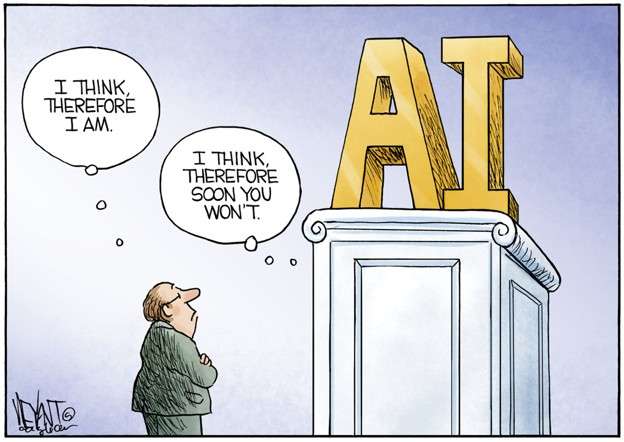
God-given life requires self-realization, which often is based on Rene Descartes’ existential formulation of “I think, therefore I am” (which he advanced almost 4 centuries ago). Many have treated that formula as a litmus for “being.” That is, the definition of humanness requires the existence of a “self” that possesses introspection and spirituality. The successful development of true AGI is intended to possess all of its learned human attributes. Descartes asserted that the very act of doubting one’s own existence served—at a minimum—as proof of the reality of one’s own “self” and therefore of its God-given essence. There must be sentience, a personal identity that recognizes that others also have an identity, for there to be “existence” in the theological, Descartian sense. A simple AI search of whether a yet-to-be-developed AGI could ponder “I think, therefore I am” results in a straightforward “no”: “AGI is a hypothetical form of machine intelligence that does not satisfy the philosophical test of soul or biological-style awareness.” If correct, AGI therefore could not be “alive” because it would not be self-aware (and therefore cannot possess a self or a soul) and so cannot be an existential threat to humanity. Is such a straightforward conclusion that simple? Since there is not, as yet, artificial general intelligence, any conclusion is speculative. However, as a working hypothesis, such a conclusion is surprisingly definitive because it denies the very goal of AGI. What, one may ask, motivated AI to respond in that fashion?
Is it too soon for the pitchforks to come out?
Finally (from a good friend)

No Comments